







- oscar
- No Comments
- June 10, 2026
Blocked Drains in Sydney: What Causes Them, How to Clear One Safely, and When to Call a Plumber
If you’re standing in a shower that’s slowly filling around your ankles, or the toilet gurgled when you ran the kitchen tap, you already know something isn’t right. Blocked drains have a way of going from mildly annoying to genuinely stressful in a day or two especially once the water starts backing up or there’s a smell you can’t ignore.
The good news is that a lot of early blockages can be sorted with a few safe checks at home. The important part is knowing which ones you can handle yourself and which are a warning sign of something bigger happening underground particularly in Sydney, where tree roots and ageing clay pipes cause a large share of the serious blockages we see.
This will walks through what’s actually causing the blockage, what you can safely try first, how the pros clear drains properly, what it tends to cost, and how to stop it happening again.
Quick answer: Most blocked drains are caused by a build up of hair, grease, food scraps, soap or “flushable” wipes or, in older Sydney suburbs, by tree roots growing into cracked pipes. For a single slow drain you can safely try a plunger, a hand drain snake, or hot (not boiling) water first. Call a licensed plumber if more than one fixture drains slowly, the toilet gurgles or backs up, water surfaces at an outside gully, or you smell sewage these point to a blockage deep in the line that DIY won’t fix. Recurring blockages almost always mean a root cause underground that needs a CCTV camera to find.
What actually causes a blocked drain?
Blockages rarely appear out of nowhere. They build up over weeks or months until one last thing tips the pipe over the edge. These are the usual offenders.
The everyday culprits inside the house
In bathrooms it’s almost always hair and soap scum binding together in the trap and along the pipe walls. In kitchens it’s fats, oils and grease – they go down warm and liquid, then cool and set hard like candle wax, catching every coffee ground and food scrap that follows. Add the occasional bottle cap, kid’s toy or build up of toothpaste and you’ve got the classic household blockage.
The other big one is wet wipes. Even the ones labelled “flushable” don’t break down the way toilet paper does. Sydney Water is blunt about this: only the “3 Ps” – pee, poo and (toilet) paper – should ever go down the toilet. Everything else belongs in the bin. Wipes, paper towel, tissues, cotton buds and sanitary products are a leading cause of the blockages crews are called out to across the network.
Tree roots – the big one in older Sydney suburbs
If you live in an established suburb with mature trees the Inner West terraces, the leafy parts of the North Shore, or any older Federation home – tree roots are the number-one cause of serious blocked drains. Roots are drawn to the small amount of moisture and nutrients seeping from joints and hairline cracks in your sewer pipe. They work their way in, then keep growing until they form a dense mat that catches everything draining past.
Sydney Water’s guidance is to avoid planting trees within about six metres of your wastewater pipes, and you can check where those pipes run by looking up your property’s sewer service diagram. Once roots are in, cutting them back clears the blockage but doesn’t fix the crack they came through – which is why root blockages tend to return every few months until the pipe itself is repaired or relined.
Old earthenware and collapsed pipes
Plenty of Sydney homes built before the 1980s still have their original earthenware (clay) sewer pipes. Over decades these crack, the joints shift with ground movement, and sections can partially collapse or sag into a “belly” that holds water and debris. The result is a pipe that snags waste constantly and blocks far more often than a modern PVC line. A camera inspection is the only way to know for sure whether you’re dealing with a simple clog or a damaged pipe.
Stormwater drains and heavy Sydney rain
Not every blocked drain is a sewer problem. Stormwater drains – the ones carrying roof and surface water away – clog with leaves, silt, sediment and garden debris, and you’ll usually only notice when a Sydney downpour sends water pooling around the house instead of draining away. Tree-heavy and coastal suburbs cop this the most each storm season.
Why does my drain keep blocking, even after I clear it?
This is the question we get asked most, and the answer is almost always the same: clearing the symptom isn’t the same as fixing the cause. If a drain blocks again within weeks or months, something structural is going on – usually tree roots, a cracked or sagging pipe, or a partial collapse. A plunger or a supermarket drain cleaner might get things flowing for a while, but it won’t remove a root mass or repair a broken pipe. Recurring blockages are the clearest sign you need a camera down the line to see what’s really happening.
What can I safely check or try first?
For a single slow drain with no other warning signs, there’s no harm in trying a few simple things before you pick up the phone.
- Clear the obvious. Lift out the drain grate and remove visible hair, gunk or food. In the kitchen, check and clean the sink trap (the U-bend): put a bucket underneath, unscrew it, clear it, and screw it back up.
- Try a plunger. A good cup plunger over a sink, bath or shower drain shifts a surprising number of soft blockages. Block the overflow with a wet cloth so you get proper suction.
- Use hot water, not boiling. Hot tap water helps loosen grease. Avoid tipping boiling water into PVC pipes or a porcelain bowl – it can soften joints or crack the ceramic.
- Bicarb and vinegar. A cup of bicarb soda followed by white vinegar, left to fizz and then flushed with warm water, is a mild, pipe-friendly option for light kitchen and bathroom build-up.
- A hand drain snake. A small hand auger can hook hair clogs near the opening. Don’t force it – if it won’t pass, stop.
- Check the outside gully. Find your overflow gully (the grate outside, usually near the bathroom or kitchen wall) and clear leaves and debris from around it.
Why I would think twice about chemical drain cleaners
Caustic supermarket drain cleaners are hard on you and your pipes. They can give off fumes, burn skin and eyes, sit in the trap and damage older pipework, and they rarely touch the real cause of a deeper blockage. If you’ve already poured one in and it hasn’t worked, tell your plumber before they start – that liquid is still sitting in the pipe and it’s a genuine safety issue for them. For most homes, a plunger and a snake are safer and just as effective on surface clogs.
When should I call a licensed plumber?
Some signs mean it’s time to stop the DIY and get a professional in. Call a plumber if:
- More than one fixture is slow or backing up at the same time – for example, the shower gurgles when the toilet flushes. That points to a blockage in the main line, not one fixture.
- The toilet bubbles, rises, or won’t clear.
- Water or sewage surfaces at an outside gully or in the garden.
- There’s a persistent sewage or rotten-egg smell.
- The drain keeps blocking no matter what you do.
In NSW, drainage and sewer work must be carried out by a licensed plumber or drainer – that’s not just a quality preference, it’s the law, and it exists to protect your health and your home. A licensed plumber can also issue the right compliance paperwork for work on your sanitary drainage.
How do plumbers actually clear a blocked drain?
A proper job is about finding and removing the cause, then checking the pipe is sound. Here’s what the main methods do:
Method | What it is best for |
| Plunger / hand auger | Minor clogs near a single fixture |
| Electric drain machine (“eel”) | Cutting through roots and tougher blockages in the line |
| High-pressure water jetter (hydro-jet) | Scouring grease, sludge and root debris off the full pipe wall |
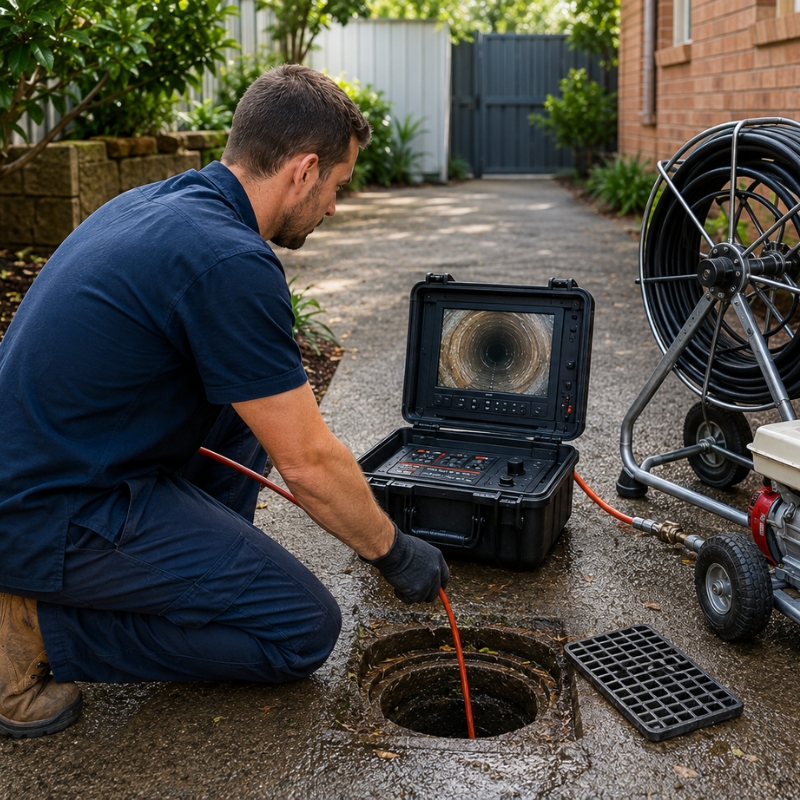
| CCTV camera inspection | Finding the exact cause and location, and checking for cracks or collapse |
| Pipe relining | Repairing cracked or root-damaged pipes from the inside – no digging |
For a one off clog, an eel or jetter usually does it. For anything recurring, a camera inspection earns its keep – it turns guesswork into a clear picture, and it’s how you find out whether you need a simple clean or a pipe repair. Where the pipe is cracked or root-damaged, relining can rebuild it from the inside without digging up your garden or driveway.
How much does it cost to clear a blocked drain in Sydney?
There’s no single price, and any plumber who quotes a firm figure before seeing the job is guessing. What actually drives the cost:
- Severity and location of the blockage. A clog near a fixture is quick; one deep in the main line takes more.
- The method needed. A basic clear with an eel sits at the lower end; hydro-jetting and CCTV cost more because of the equipment.
- Access. An easy-to-reach inspection opening keeps costs down; awkward or buried pipes take longer.
- Time of day. After-hours and emergency callouts cost more than a booked daytime visit.
- Diagnosis and repair. A camera inspection, and any relining or excavation if the pipe is damaged, are separate from a basic clear.
The honest approach: get the drain cleared, get a camera down it if it’s a repeat problem, and get a written quote for any repair before work starts.
Blocked drains in older homes, apartments and cafes
Older Sydney homes and terraces. Original clay pipes, mature street trees and shared boundary drains make root blockages common – and in a terrace your line may run under the neighbour’s place or be shared, which complicates who pays.
Strata and apartments. In a unit, a blockage can be in your own branch line or in the common-property stack. If several neighbours have the same issue at once, it’s likely a shared line and a strata matter – worth checking before you pay for a private callout.
Cafes, restaurants and commercial kitchens. Grease is the enemy. Commercial kitchens block far more often without a properly maintained grease trap and regular drain cleaning, and a blocked drain that shuts the kitchen for a day is an expensive problem. Scheduled jetting is far cheaper than emergency downtime.
Who is responsible – you, Sydney Water, or the council?
A quick rule of thumb. You’re responsible for the pipes that serve only your property, up to the point where they connect to Sydney Water’s main. Sydney Water looks after its own network – so if an overflow is coming from a Sydney Water main, or your neighbours share the exact same problem, it may be their responsibility, and in some cases you can claim back a licensed plumber’s costs if they find the blockage is in Sydney Water’s pipe (provided it’s reported first). Stormwater is different again: your private stormwater pipes are yours, while the public stormwater system is the council’s. When in doubt, a licensed plumber can tell you which side of the boundary the problem is on.
Common mistakes to avoid
- Reaching for caustic drain cleaner every time – it masks the cause and can damage pipes.
- Flushing “flushable” wipes. They’re the single easiest blockage to prevent.
- Ignoring slow drains and gurgles until they become a full backup (and an after-hours callout).
- Tipping fat and oil down the sink. Let it set and bin it instead.
- Clearing a recurring blockage again and again without ever getting a camera down to find why.
How do I stop my drains blocking in the first place?
Prevention is mostly small habits:
- Stick to the 3 Ps in the toilet – pee, poo and paper only.
- Keep fats, oils and grease out of the sink; wipe greasy pans before washing up.
- Fit cheap drain guards over shower, bath and kitchen plugholes to catch hair and scraps.
- Run hot water through the kitchen sink after washing up to keep grease moving.
- Clear leaves from outside gullies and stormwater grates before storm season.
- If you’re planting, keep trees well clear of where your sewer line runs – Sydney Water suggests around six metres.
- For a drain that’s blocked before, a periodic hydro-jet and a one-off camera inspection can catch a problem while it’s still cheap to fix.
Frequently asked questions
Why does my drain keep blocking again?
Recurring blockages almost always mean a structural cause underground – usually tree roots, a cracked pipe, or a sagging section that holds water and debris. Clearing the blockage treats the symptom; until the pipe itself is inspected with a camera and repaired or relined, it tends to come back every few months.
Can I clear a blocked drain myself?
For a single slow drain you can safely try a plunger, a hand drain snake, hot (not boiling) water, or bicarb and vinegar. If more than one fixture is affected, the toilet is backing up, or water surfaces outside, stop and call a licensed plumber – that is a main-line problem and DIY will not fix it.
Is it safe to use chemical drain cleaner?
It is best avoided. Caustic drain cleaners can release fumes, burn skin and eyes, damage older pipes, and rarely clear a deeper blockage. A plunger and a snake are safer for surface clogs. If you have already used one and it did not work, tell your plumber before they start, as the chemical is still in the pipe.
How do I know if it is a sewer blockage or just a clog?
If only one fixture is slow, it is usually a local clog. If several fixtures gurgle or back up together, the toilet bubbles, or water rises at an outside gully, the blockage is in your main sewer line and needs a licensed plumber.
How much does it cost to unblock a drain in Sydney?
There is no fixed price – it depends on the severity and location of the blockage, the method (a basic eel clear is cheaper than hydro-jetting or CCTV), how easy the pipe is to access, and whether it is an after-hours callout. Always get a written quote before any repair work.
Who is responsible for a blocked drain – me or Sydney Water?
You are responsible for the pipes that serve only your property up to where they connect to Sydney Water’s network; Sydney Water looks after its own mains. Private stormwater pipes are yours, while the public stormwater system is the council’s. A licensed plumber can confirm which side of the boundary the problem is on.
What is pipe relining and do I need it?
Pipe relining repairs a cracked or root-damaged pipe from the inside by curing a new lining in place – no digging up the garden. It is the usual fix when a camera shows the pipe itself is damaged and is why the drain keeps blocking.
Need a hand with a blocked drain in Sydney?
Blocked drains usually start small and get worse quietly, so the cheapest time to deal with one is early. If you’ve tried the safe basics and the water still isn’t moving or it keeps coming back, it’s worth getting a licensed Sydney plumber to take a proper look, camera included, so you fix the cause and not just the symptom. Apex Plumbing Services helps homes, strata and businesses right across Sydney with blocked drains, stormwater and pipe repairs, including after-hours emergencies.

