







How to Tell If a Pipe Is About to Burst (Early Warning Signs Sydney Homeowners Miss)
Most burst pipes don’t “come out of nowhere”. In many Sydney homes, the need for burst pipe repair is preceded by quiet warning signs for days or weeks beforehand—small changes in pressure, odd noises, damp patches, or a smell that doesn’t quite go away.
The problem is that the early signs often look like harmless annoyances. A little mould in a corner. A slightly weaker shower. A tap that bangs once in a while. And then suddenly you’re dealing with soaked plasterboard, warped flooring, or water dripping through a ceiling.
This guide is designed to help Sydney homeowners spot the signs early, confirm whether you’re likely dealing with a stressed pipe, and know when the risk is high enough to stop guessing and act.
Why pipes “almost burst” before they burst
A pipe rarely fails instantly unless there’s a major event (like a dig-through, impact damage, or a severe pressure spike). More commonly, pipes deteriorate and weaken over time due to:
• Corrosion (especially in older metal pipework)
• Tiny “pinhole” leaks that expand
• Water pressure that’s consistently too high
• Water hammer (shockwaves when water stops suddenly)
• Ground movement, tree roots, or settling (more common around older properties)
• Ageing fittings and flexi hoses under sinks and behind toilets
• Temperature changes (winter can expose weaknesses)
In Sydney, a mix of older housing stock, renovations that connect new fittings to old lines, and plenty of strata living (shared pipe runs) can make it harder to tell where a problem is starting.
The early warning signs Sydney homeowners miss
1) Sudden or gradual drop in water pressure (especially whole-house)
If your water pressure drops in just one tap, the cause might be local (a blocked aerator, a worn washer, a tap issue). But if multiple fixtures across the house change at the same time—shower, kitchen, bathroom—pay attention.
Whole-house pressure drops can point to:
• A leak developing on the supply line
• A failing pressure limiting valve (PLV/PRV)
• A partially closed main shut-off valve (sometimes after recent work)
• A pipe narrowing internally due to corrosion or mineral build-up
What makes this “about to burst” territory is when the pressure changes are paired with other signs (noise, dampness, higher bills, or visible staining).
2) Banging, thumping, or “machine-gun” sounds in the walls
That sharp bang when the washing machine stops, or when you flick off a tap fast? That’s often water hammer—pressure shockwaves slamming through the pipework.
Occasional mild water hammer can happen in many homes, but repeated banging can:
• Loosen joints and fittings
• Stress weak sections of pipe
• Accelerate small cracks into major splits
If the banging is new, louder than usual, or happens across multiple taps/appliances, treat it as a warning—particularly in older homes or properties with mixed old/new plumbing.
3) Damp patches, bubbling paint, or peeling plasterboard
A pipe that’s weeping behind a wall can create subtle clues before there’s visible dripping.
Look for:
• Paint that bubbles or blisters
• Plasterboard that feels soft or spongy
• Skirting boards swelling or separating
• A damp patch that slowly expands
• Wallpaper lifting, even slightly
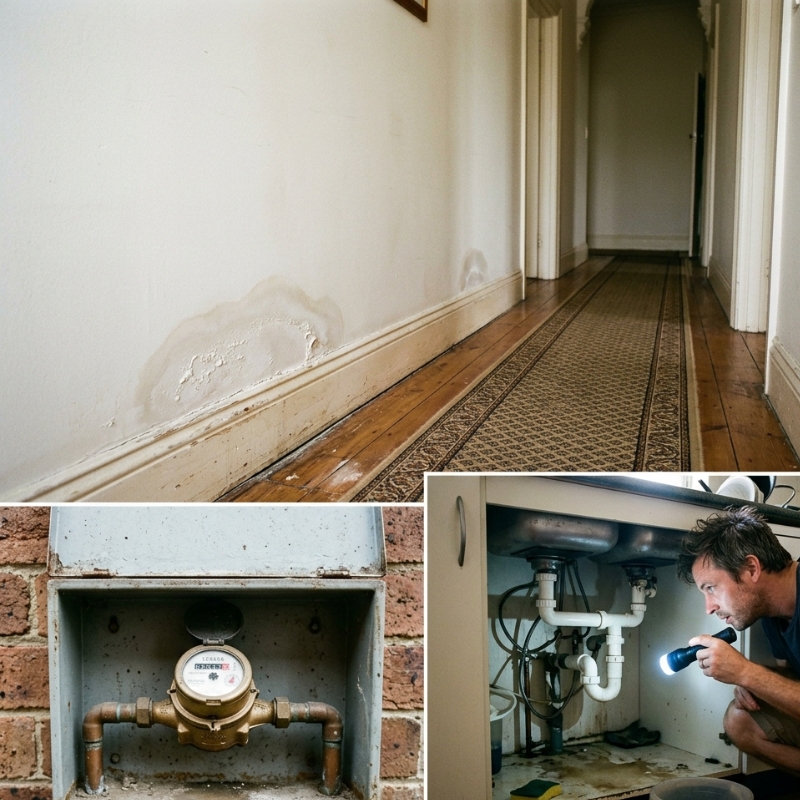
In Sydney’s humidity, a slow leak can look like “just mould” at first—until the wall cavity becomes saturated.
4) A musty smell that returns after cleaning
If you clean a “mouldy” spot and it comes back quickly, the issue might not be airflow or bathroom steam. Persistent musty odours can mean moisture is trapped in a wall, ceiling, or under flooring.
A strong clue is when the smell is:
• Localised to one area (one cupboard, one corner, one hallway)
• Stronger after water use (showers, washing machine, dishwasher)
• Paired with a slightly damp feel underfoot
5) Unexplained spike in your water usage or bill
Even a small leak can waste a surprising amount of water over time. If your usage jumps but your household routine hasn’t changed, treat it as a practical sign that something is going on.
This is where a quick water meter test becomes one of the most useful homeowner checks.
How do I use my water meter to check for a leak?
A simple approach is:
• Turn off taps and water-using appliances (dishwasher, washing machine, irrigation timers).
• Make sure no one uses water during the test window.
• Check your meter reading, wait a short period, then check again.
If the meter changes while everything is off, water is likely moving somewhere it shouldn’t.
6) Water stains on ceilings (especially in strata apartments)
Ceiling stains are a classic “this is nothing” sign—particularly in units, where water can travel from above or along structural pathways.
If you notice:
• Yellow/brown staining
• A ring-shaped watermark that grows over time
• Paint that cracks or peels on the ceiling
• Sagging plasterboard
Treat it as urgent. In strata, delays can multiply damage because the source may be in another lot or common property.
If I’m in a unit, who’s responsible for the pipes?
In NSW strata, responsibility can depend on whether the issue is within your lot or in common property. As a practical step:
• Document the signs (photos, dates, affected areas).
• Notify your strata manager/building manager early.
• Don’t assume it’s “your problem” or “their problem” until it’s inspected—time matters most.
If you want the official NSW guidance as a starting point, see: NSW strata repairs and maintenance.
7) Rusty, brown, or cloudy water (especially from one side: hot or cold)
Discoloured water can happen after water main work, but if it persists, it can signal corrosion or sediment within the pipework or the hot water system.
Patterns matter:
• Only hot water discoloured: hot water unit or hot-water lines may be involved
• Only one tap: local issue in that branch
• Multiple taps over time: broader corrosion or disturbance
If discolouration appears alongside pressure changes and new pipe noises, it’s worth treating as a warning sign rather than a one-off inconvenience.
8) Wet patches outside, soggy garden areas, or a constantly damp driveway edge
For standalone homes, a leak on an underground supply line can show up outside before it shows up inside.
Watch for:
• A patch of lawn that stays greener than the rest
• A soft, boggy spot that never dries
• Water pooling near the meter box
• Dampness at the slab edge
In some Sydney areas, ground movement and tree roots can add stress to underground lines—especially where older pipe materials are present.
9) Constantly running toilet or “mystery refills”
Toilets are one of the most common silent water wasters. While this doesn’t always mean a pipe is about to burst, it can:
• Mask other leaks (your bill is already high)
• Increase overall system wear
• Create ongoing moisture issues in a bathroom or wall
If the toilet is constantly refilling, fix it promptly—and still run a meter check to rule out additional leaks.
10) Under-sink flexi hoses that bulge, kink, or look corroded
Some of the most sudden indoor floods come from flexi hoses or fittings failing under pressure, especially under kitchen sinks, vanity units, and behind toilets.
Red flags include:
• Rust staining on the braided hose
• Bulging or kinks
• Moisture around the join, even when taps aren’t running
• Green/white mineral build-up on fittings
If you spot these, don’t wait for failure—these are relatively easy to address compared to structural water damage.
A quick “risk level” checklist: monitor vs act today
Low to moderate risk (monitor closely, run checks)
• Slight pressure change at one tap only
• A small, stable damp patch that isn’t growing
• Occasional mild pipe noise with no other symptoms
• One-off discoloured water after local works
Actions:
• Clean aerators and check fixture-specific causes
• Do a water meter leak test
• Note dates and whether symptoms worsen after water use
Higher risk (act today)
• Whole-house pressure drop or fluctuations
• New loud banging/water hammer across fixtures
• Damp patch growing or ceiling staining
• Musty smell plus visible moisture signs
• Meter movement when water is off
Actions:
• Locate your shut-off valve now (don’t wait)
• Minimise water use until assessed
• Consider a licensed plumber inspection to prevent escalation
Emergency risk (treat as urgent)
• Water near electrical points or light fittings
• Ceiling sagging, dripping, or bulging
• Rapidly spreading dampness
• You can hear water running with everything off
• Water pooling indoors or outside near foundations
Actions:
• Shut off water at the mains if safe
• Avoid switching lights on/off near wet areas
• Get professional help urgently
If you’re already seeing high-risk signs and things are escalating, it helps to know what typically happens next with burst pipe repairs in Sydney so you can act fast and limit damage.
Simple at-home checks (that don’t require special tools)
Check 1: Whole-house vs single-fixture pressure pattern
• If only one tap is weak: likely local
• If everything is weak: suspect supply-side leak, valve issue, or regulator problem
• If pressure “pulses” or surges: possible regulator instability or a developing restriction/leak
Check 2: Listen at consistent times
Do you hear banging?
• When washing machine stop?
• When does the dishwasher finish filling?
• When a tap is flicked off quickly?
If yes, it’s worth addressing water hammer early because it’s a stress multiplier on vulnerable pipework.
Check 3: Visual scan of “high-risk zones”
Do a quick lap of:
• Under sinks (kitchen, vanity, laundry)
• Behind/around toilets
• Around the hot water unit
• Ceiling corners below bathrooms/laundry areas
• Meter box area outside
You’re looking for moisture, corrosion, staining, or mineral build-up.
What’s the difference between a small leak and a pipe about to burst?
A small leak is often stable (a slow drip at a joint, a minor seep). A pipe “about to burst” is more likely when:
• Multiple symptoms appear together (pressure change + noise + dampness)
• The symptoms are worsening over time
• The location is hidden (behind walls/ceilings) and damage is spreading
• There’s evidence of pressure stress (water hammer, surging)
Sydney-specific scenarios and what they usually mean
Scenario 1: “My shower pressure dropped, and now the pipes bang sometimes”
Common possibilities:
• Water hammer worsening due to pressure/flow changes
• Regulator issues
• A leak is developing that’s reducing overall pressure
What to do:
• Run the meter test
• Check if multiple fixtures are affected
• If banging is increasing, treat it as a higher risk
Scenario 2: “There’s a ceiling stain under the upstairs bathroom”
Common possibilities:
• Leak at a bathroom fitting, shower recess, or pipe joint
• Water tracking along joists and showing up away from the source
What to do:
• Document the stain growth (photos over 24–48 hours)
• Minimise water use in the area
• In strata, notify early
• Don’t ignore sagging or bubbling paint
Scenario 3: “One corner of the living room smells musty, but I can’t see water”
Common possibilities:
• Slow leak behind a wall
• Underfloor moisture wicking upward
• Leak from an adjacent wet area
What to do:
• Check the meter with everything off
• Inspect skirting boards and carpet edges
• If the smell intensifies after showers/laundry cycles, suspect plumbing moisture
Scenario 4: “My garden has a wet patch near the meter”
Common possibilities:
• Underground leak on the supply line
• Leak at the meter connection or nearby fittings
What to do:
• Meter test is especially useful here
• Treat it as urgent if water is pooling near the slab edge/foundations
If the signs are stacking up and you’re worried things could worsen quickly, keeping a plan in mind for emergency burst pipe help can make the difference between a manageable clean-up and major water damage.
Prevention tips that actually reduce burst risk
Prevention isn’t about doing everything—it’s about reducing stress on your plumbing system.
Manage pressure stress
• If your home has persistent water hammer, address it early
• Consider checking whether your pressure limiting valve is functioning correctly (a plumber can test and confirm)
• Avoid “quick shut-off” habits where possible (slamming taps off, especially older fixtures)
Replace high-risk flexi hoses proactively
• If hoses look corroded, kinked, or old, replacing them can prevent sudden indoor flooding
• Pay extra attention to hoses hidden in cupboards you rarely open
Keep an eye on wet areas and ceilings
• Small stains grow—track them
• If mould returns quickly after cleaning, look deeper than surface-level fixes
Don’t ignore “minor” signs in winter
Sydney winters aren’t extreme, but seasonal changes can still expose weaknesses:
• You might run hot water more often
• Rain and humidity can mask plumbing dampness
• Temperature shifts can change how materials expand/contract
When should I stop DIY checks and call a licensed plumber?
Call sooner (not later) if:
• Your meter moves when all water is off
• You have whole-house pressure drops or surging
• You see ceiling staining, sagging, or water near lights
• You can’t locate the source, but signs are increasing
• You have an older home, and symptoms have appeared suddenly
When the meter test shows movement, pressure becomes unpredictable, or moisture is spreading, that’s usually the point where a licensed plumber for burst pipes can properly isolate the issue and prevent a full failure.
Final FAQ (Sydney homeowners)
Can a pipe be “about to burst” even if there’s no visible leak?
Yes. Many failures start as internal corrosion, a weakening joint, or pressure stress inside wall cavities. Visible water can be the last symptom, not the first.
Is low water pressure always a sign of a leak?
Not always. It can be fixture-related or caused by a regulator/valve issue. But whole-house pressure drops—especially paired with dampness or meter movement—raise the odds of a leak or developing failure.
What does water hammer sound like?
Typically, a sharp bang, thud, or knocking noise when water stops suddenly (tap off, appliance valve closes). Frequent hammering can loosen joints and accelerate failures.
Why do ceiling stains matter so much?
Because water can travel along framing and surfaces, so the stain may appear far from the source. Also, wet ceilings can become a safety issue, especially near lighting.
How long can a slow leak go unnoticed?
Weeks or months, depending on where it is. Hidden leaks often show up as smells, mould recurrence, subtle swelling, or a creeping water bill.
If I’m in a strata unit, should I still run a water meter test?
You can, but the meter may be shared or not specific to your lot, depending on the building setup. Still: document signs, notify strata early, and get guidance before damage spreads.
What’s the fastest way to reduce damage risk if I suspect imminent failure?
Know where your main shut-off is, minimise water use, and act quickly if the signs escalate (especially ceiling stains, strong musty smells, or whole-house pressure changes).

