








How to Tell If Your Gas Appliances Are Unsafe (And What to Check First)
Gas appliances are usually “set and forget” until something feels off: a smell you can’t place, a cooktop that won’t light cleanly, a heater that makes you drowsy, or hot water that suddenly turns temperamental. The tricky bit is that “unsafe” doesn’t always look dramatic—and sometimes the cause is linked to gas fitting (or a related connection or setup issue), even when the symptoms seem minor. Some of the most important warning signs are subtle, and they’re easy to dismiss when you’re busy.
This guide is written for Sydney homes and apartments, using plain, practical checks you can do without tools and without touching gas components. You’ll learn:
• The clear red flags that mean “treat this as urgent”
• The early warning signs that mean “stop using it and get it assessed”
• What “normal” flames and operation should look like
• What to check first (safely) in the kitchen, laundry, and around heaters
• The most common myths that get people into trouble
If you ever feel unsure, it’s completely reasonable to stop using the appliance and have it checked by a licensed professional. Gas issues can escalate quickly, and peace of mind is worth a lot.
The two risks people mix up: gas leaks vs unsafe combustion
When people say “gas appliance isn’t safe”, they’re usually talking about one (or both) of these:
• Gas escaping where it shouldn’t (leaks in connections, flexible hoses, valves, or inside the appliance)
• Gas burning poorly (incomplete combustion that can produce soot and, in some cases, carbon monoxide)
A leak risk is often about ignition and explosion hazards. Poor combustion is often about indoor air quality and health. Both matter. The checks below help you decide which situation you might be in and what to do next.
If you suspect a gas leak, treat it like an emergency first
What a gas leak can smell like in Sydney homes
Natural gas is odourised so you can detect it. People describe it as:
• Rotten eggs or sulphur
• A strong “gassy” chemical smell
• A persistent odour around the cooktop, meter, or hot water unit
Sometimes it’s faint and comes and goes, especially if it’s influenced by airflow, open windows, rangehoods, or temperature changes.
What to do immediately if you smell gas strongly
If the smell is strong, worsening, or making anyone feel unwell:
• Don’t use matches, lighters, or anything with a flame
• Don’t turn electrical switches on or off (including lights, fans, power points)
• If it’s safe to do so, open doors and windows to ventilate
• Move everyone (and pets) outside to fresh air
• If you can safely access it, turn the gas off at the meter/main shut-off
• Contact your gas distributor’s emergency number or emergency services (follow local guidance)
If you’re in an apartment building, follow building procedures and notify building management as well.
Q&A: “What if the smell is faint and I’m not sure?”
If you only notice it occasionally (for example, only near one appliance), treat it as a warning sign, not something to ignore. Stop using that appliance and work through the “safe first checks” below. If the smell returns, it’s time for a professional assessment. A small leak can become a bigger problem.
The safest “first checks” you can do without touching gas parts
These checks are observation-based. They don’t involve tightening fittings, removing panels, or changing settings you don’t understand.
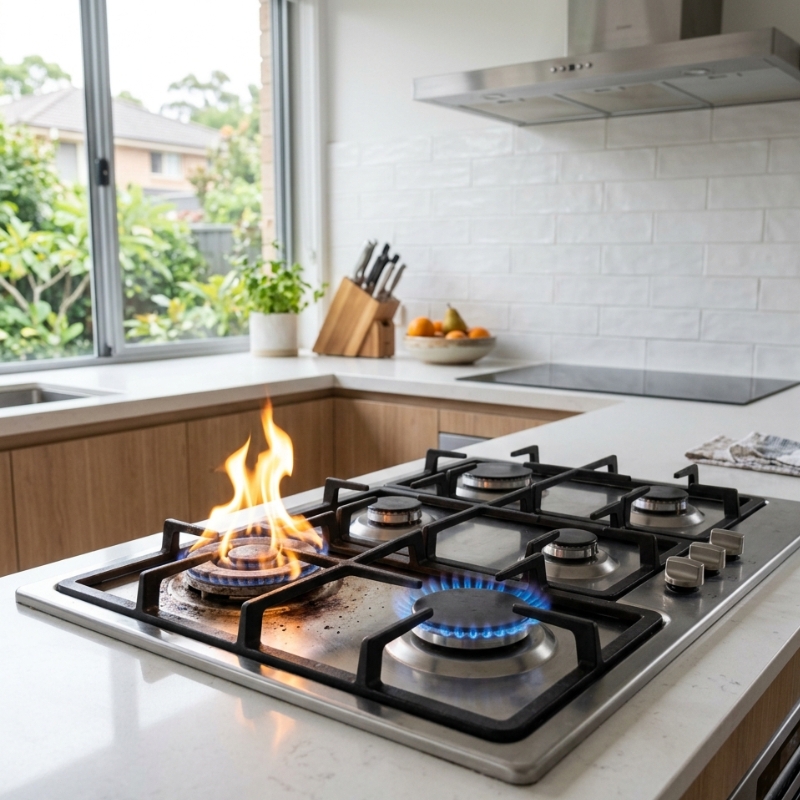
Check 1: Look at the flame colour (where you can see it)
For cooktops and older-style heaters, a healthy flame is typically:
• Mostly blue
• Steady and even
• Not lifting off the burner ports
Warning signs include:
• Yellow or orange flames that persist (not just a brief flicker when lighting)
• Flames that look lazy, uneven, or “rolling”
• Flames that lift, blow around easily, or make a roaring noise
Yellow flames can be linked to poor air-to-gas mix, blocked burner ports, dirt/grease, or ventilation/pressure issues. It doesn’t automatically mean carbon monoxide is present, but it does mean the appliance isn’t operating as it should and should be checked.
Check 2: Look for soot, staining, or scorching
Soot is a strong clue that combustion isn’t clean.
Look for:
• Black soot marks on walls, ceilings, or around vents/flues
• Browning or scorching around the appliance case
• Sooty residue on cookware bottoms more than usual
• Dust patterns around vents that look like smoke staining
Any fresh soot around a gas heater or around a flued appliance is a “stop and assess” moment.
Check 3: Listen for changes in normal operation
Gas appliances have a normal sound profile. The problem is we only notice it once it changes.
Warning sounds:
• Repeated clicking that doesn’t stop after ignition
• Popping, banging, or “whoomph” ignition sounds
• Hissing near the appliance when it’s off (treat cautiously)
• A burner that sounds like it’s struggling or surging
Check 4: Watch for performance changes
Some performance issues are minor. Others point to unsafe operation.
Red flags include:
• Burners that frequently go out on their own
• A pilot light that won’t stay lit (older units)
• Strong gas smell during operation
• Hot water temperature swings that are sudden and persistent
• A heater that causes eye irritation or headaches indoors
Check 5: Check ventilation and airflow basics
Sydney homes vary wildly: older terraces, renovated units, new builds with tight seals. Combustion appliances need appropriate ventilation.
Quick ventilation checks:
• Is the room often sealed up (especially in winter)?
• Are vents blocked by furniture, curtains, or DIY covers?
• Does the rangehood vent outside (not recirculating only) and is the filter clean?
• Do you notice condensation on windows when appliances run?
Ventilation problems don’t “create” a gas fault, but they can make an existing issue more dangerous.
Room-by-room: what unsafe can look like
Kitchen: cooktops and ovens
Common warning signs:
• Persistent yellow flames on one or more burners
• Burners that ignite slowly, unevenly, or with a small “bang”
• Burners that keep clicking even after they’re lit
• A smell of gas when the oven is on, or after turning it off
• Heavy soot on the underside of pans
Safe first steps:
• Turn burners off and let the room ventilate
• Clean obvious food debris from around burner caps (only if cool and safe), and ensure caps are seated correctly
• If the issue persists after basic cleaning and correct placement, stop using it
What not to do:
• Don’t adjust jets, regulators, or internal settings
• Don’t keep “trying again” repeatedly if ignition is delayed
Q&A: “My cooktop keeps clicking. Is that dangerous?”
It can be. Clicking usually means the ignition system is still trying to spark. Sometimes it’s moisture or grime, but if ignition is delayed or inconsistent, unburnt gas may be present briefly before it lights. If cleaning and drying doesn’t resolve it quickly, stop using it and have it checked.
If you want a simple framework for what’s normal vs concerning, keep a copy of this gas appliance safety check handy and run through it when something changes.
Laundry/utility: gas hot water systems
Hot water systems can fail in ways that look “annoying” rather than “unsafe”, but some symptoms matter.
Warning signs:
• A “hot then cold” pattern that’s sudden and keeps happening
• A pilot light that won’t stay lit on older units
• Sooting around the unit or on nearby surfaces
• Signs of scorching near the flue area
• Unusual smells during operation
Safe first steps:
• Ventilate the area
• Check for obvious obstructions around the unit (stored items too close, blocked vents)
• If you notice soot, scorching, or repeated shutdowns, stop using it
Living areas: gas heaters
Heaters are where “unsafe combustion” matters most because you’re in the room breathing the air.
Warning signs you should take seriously:
• Headaches, dizziness, nausea, unusual fatigue when the heater is running
• Symptoms that improve when you leave the room or open windows
• Soot marks near the heater or vents
• Persistent yellow/orange flames
• The room feels stuffy or you notice eye irritation
Carbon monoxide (CO) is colourless and odourless. It can’t be detected by smell. NSW Health guidance on carbon monoxide symptoms and prevention is worth reading and sharing with your household: Carbon monoxide poisoning information from NSW Health.
If anyone has serious symptoms (confusion, chest pain, collapse), treat it as a medical emergency and get help immediately.
A simple triage: “stop now”, “stop soon”, or “monitor”
Stop now (treat as urgent)
• Strong gas smell indoors or around the meter/appliance
• Hissing sound near a gas component (especially when off)
• Sooting/scorching that looks fresh or is increasing
• Anyone feels unwell when an appliance is running (especially a heater)
• Flames lifting, surging, or behaving unpredictably
Stop soon (don’t keep using it)
• Persistent yellow/orange flames
• Repeated ignition problems or delayed lighting
• Pilot light issues that keep returning
• Unusual smells during operation (not just cooking odours)
• Performance changes that don’t resolve with basic cleaning/ventilation
Monitor (but keep a close eye)
• A one-off issue that clearly links to a spill, moisture, or temporary draft and resolves fully
• Minor clicking that stops after drying/cleaning and doesn’t return
• A single burner that’s slightly uneven but improves after correct cap placement
When in doubt, choose “stop soon”. It’s the safer call.
Common myths that cause trouble
“If I can’t smell gas, it’s safe”
Not necessarily. Poor combustion can still be risky, and carbon monoxide cannot be smelled.
“Yellow flames are normal in some homes”
A brief yellow flicker at ignition can happen, but persistent yellow/orange flames are a warning sign that something isn’t right.
“I’ll just tighten the fitting a bit”
Please don’t. DIY tightening can damage threads, crush seals, or create leaks where none existed. It also makes it harder for a professional to diagnose what changed.
“Opening a window fixes everything”
Ventilation helps, but it doesn’t fix a fault. If the appliance is producing soot or triggering symptoms, the appliance needs assessment, not just airflow.
What to check first in the first 60 seconds
If something seems off and you’re not sure what you’re dealing with, do this:
• Turn the appliance off
• Open windows/doors for airflow
• Move people to fresh air if anyone feels unwell
• Look for obvious soot/scorching
• If it’s a cooktop, check flame colour (blue vs persistent yellow)
• If you smell gas, don’t operate switches or flames
If you’d like a clear “what happens next” pathway in Sydney, this overview of gas leak warning signs can help you decide when it’s time to escalate.
When it’s time to involve a licensed professional
You don’t need to prove it’s unsafe before you ask for help. In practice, these are strong triggers:
• Any gas smell that returns or strengthens
• Any soot, scorching, or staining that appears around a gas appliance
• Ongoing yellow flames
• Repeated ignition issues or delayed lighting
• Any health symptoms that seem linked to appliance use
• Any appliance that repeatedly shuts down, backfires, or behaves unpredictably
In NSW, gas work must be done by appropriately licensed people. If you’re ever unsure, you can check a tradesperson’s licence through Service NSW.
If you need the “one line” rule: if you’re observing a safety sign rather than a convenience issue, it’s time to speak with a licensed gas plumber in Sydney.
Renters and strata: a quick, practical approach (Sydney/NSW)
If you’re renting or in a strata-managed building, safety still comes first.
• If you smell gas strongly or anyone feels unwell, follow emergency steps and notify building management/agent after you’re safe
• Document what you observed (dates, smells, symptoms, visible soot, flame colour)
• Don’t keep using an appliance that seems unsafe while waiting for a response
• If it’s a shared system or common area, notify strata/building management promptly
FAQs
How do I know if my gas appliance is unsafe?
Look for persistent yellow flames, soot marks, repeated ignition problems, unusual smells during operation, or health symptoms (headaches/dizziness) that worsen when an appliance runs. Strong gas smell should be treated as urgent.
What does a yellow flame on a gas cooktop mean?
A healthy flame is usually mostly blue. Persistent yellow/orange flames can indicate poor combustion due to airflow issues, dirty/blocked burner ports, or a fault that needs professional assessment.
Can a gas heater cause headaches?
Yes. Headaches, dizziness, nausea, or unusual fatigue that improve when you leave the room can be warning signs of combustion problems, including potential carbon monoxide exposure. Stop using the heater, ventilate, and seek advice. For symptom guidance, refer to NSW Health’s carbon monoxide information.
Should I turn off the gas at the meter if I smell gas?
If the smell is strong and you can safely access the meter without using switches or creating a spark risk, turning it off can be appropriate. If you’re unsure or it’s not safe to approach, prioritise getting everyone outside and contacting your gas distributor/emergency services.
Is it safe to keep using an appliance “until it gets checked”?
If you’re seeing safety signs (yellow flames, soot, symptoms, repeated ignition faults, persistent gas odour), it’s safer to stop using the appliance until it’s assessed. Continuing to use it can increase risk.
Do carbon monoxide alarms replace servicing?
No. Alarms can be one safety layer, but they don’t fix appliance faults or poor installation/ventilation problems. Servicing and safe operation habits still matter.
How often should gas appliances be serviced?
Intervals vary by appliance type, age, usage, and manufacturer guidance. If an appliance is older, used heavily (especially heaters in winter), or showing any warning signs, don’t wait for a calendar date—get it checked.

