







Who Is Responsible: the Property Owner or the Council?
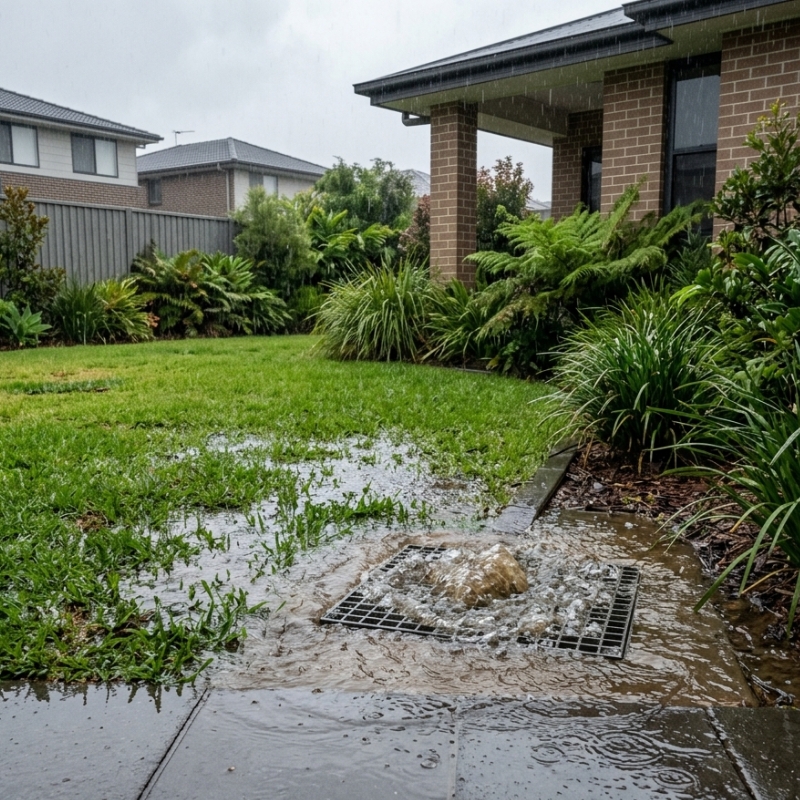
After a decent Sydney downpour, the problems tend to show up fast. Water pools across the yard and will not drain, a stormwater pit overflows, or the line simply refuses to clear. It is stressful, and the first question most homeowners ask us is a fair one.
Is a blocked stormwater drain your problem to fix, or is it the council’s? The honest answer is that it depends on where the blockage sits. Here is how the boundary usually works in Sydney, how to tell which side of it you are on, and when it is time to call a licensed plumber.
Where your responsibility ends, and the council or Sydney Water begins
As a general rule, the stormwater pipes and pits on your property are yours to maintain, right up to the point where your line connects to the public system. Past that connection point, the public stormwater network is looked after by your local council, and in some areas Sydney Water manages certain assets as well.
The catch is that this can vary from council to council, so it is worth confirming rather than assuming. If water is banking up and you need it sorted before the next storm, we can arrange a blocked stormwater drains Sydney to find exactly where the problem sits and who is responsible for clearing it.
How to tell whether the blockage is on your side of the boundary
A few things point to where the trouble is. Notice which pits fill up first, where the water pools, and whether it drains away slowly or not at all. If the pit closest to the street backs up while the ones near the house stay clear, the blockage may be further down the line. If everything on your property struggles, the cause is more likely to be within your own pipes.
| What You Notice | What It May Indicate | Likely Location |
| Pits near the house fill first | The blockage is affecting your internal drainage | Your property |
| All pits on your property drain slowly | There may be a restriction in your private sewer line | Your property |
| The pit closest to the street backs up first | The blockage may be further down the sewer line | Near or beyond the property boundary |
| Street-side pit is full, but house-side pits are clear | The issue may be outside your private drainage system | Public sewer side |
| Water pools around one particular pit | A local blockage or damaged section may be present | Near that pit |
| Wastewater does not drain away at all | A severe blockage may be preventing normal flow | Depends on which pit fills first |
You can only take that so far from the surface, though. The clearest way to settle it is a camera inspection, which pinpoints the blockage and confirms whether it is on your land or past the boundary before anyone starts digging.
What happens during heavy rain and why pits overflow
Sydney storms can drop a lot of water in a short window, and effective stormwater management relies on a healthy system built to move it away from roofs, driveways and garden beds quickly. When leaves, silt, tree roots or a damaged pipe get in the way, that flow slows down and water starts to back up. Because the blockage is often underground and out of sight, the first sign you get is usually the overflow itself.
Overflowing pits, gutters and downpipes during rain are a common warning that the system is restricted somewhere. We have written up the early signs your stormwater system is overloaded during heavy rain if you want to go a little deeper on what to watch for.
Who to contact once you know which side it is on
If the blockage turns out to be on your side of the boundary, the council will not clear it for you, and that is where a licensed plumber comes in. It is also the safer path. Pouring drain chemicals into a stormwater line rarely fixes a real blockage, and digging near underground services without knowing what is down there can cause more damage than the original problem. Once you know the blockage sits on your side of the boundary, clearing it is your responsibility and a camera inspection is the quickest way to see what is causing it. Apex Plumbing Services clears blocked stormwater lines and overflowing pits across Sydney
If you are not sure whose responsibility it is and you want it confirmed quickly, get in touch with Apex for a same-day assessment. We will locate the blockage, tell you plainly which side of the boundary it sits on, and sort out the part that is yours.
Frequently asked questions
Is a blocked stormwater drain my responsibility or the council’s?
As a general rule, the pipes and pits on your property up to the connection point are yours, and the public network beyond that is the council’s, with Sydney Water managing some assets in certain areas. It can vary by council, so it is worth confirming. Locating the blockage is the surest way to know.
Who do I call for an overflowing stormwater pit?
If the pit is on your property, call a licensed plumber. If it is clearly part of the public system past your boundary, your local council manages it. When you are not certain, a quick inspection removes the guesswork.
Can I clear a stormwater drain myself?
You can safely clear leaves and debris from surface grates and pits. For anything underground, a recurring blockage, or a line that will not clear, it is safer to have it inspected rather than using chemicals or digging blindly near services.
How do I know if the blockage is on my property?
Watch which pits fill and where the water pools, then confirm it with a camera inspection. The camera shows the exact location and cause, so you know whether it sits on your land or past the boundary.

