










How to Tell If You Have a Hidden Water Leak, Using Your Water Meter
The bill has climbed for no reason you can point to, or there is a faint damp smell in a cupboard, but nothing anywhere is visibly dripping. It is an uncomfortable spot to be in, because a leak you cannot see still does damage while you wonder about it. The good news is that a hidden leak announces itself in small, specific ways, and there is a simple test any property owner can run with no tools at all that confirms whether water is moving when it should not be. This article walks you through that test, the warning signs worth acting on indoors and out, and how a leak is pinpointed without tearing anything apart.
Turn off every tap and appliance that uses water, then watch your water meter. If the dial or digits keep moving with nothing running, water is escaping somewhere on your side of the meter. Pair that with damp patches, unexplained warm flooring or the sound of running water to narrow the location.
The Water Meter Test, Step by Step
The meter test is the single most useful thing you can do, because it confirms a leak exists before you spend any time hunting for it. Run it like this:
- Turn off everything that uses water. Every tap inside and out, and stop the washing machine and dishwasher mid-cycle. Avoid flushing the toilet for the whole test, since a flush will move the meter and muddy the result.
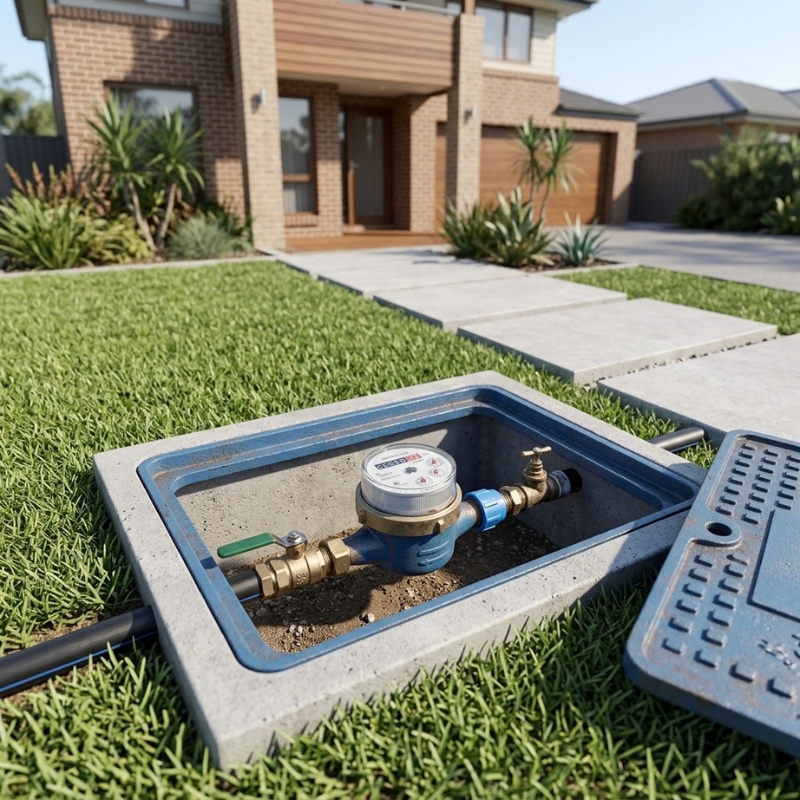
- Find your meter. It is usually in a boundary box near the front of the property, often near the footpath.
- Note the full reading and photograph it. Record everything, including the fine dial or the final digits, because a slow leak only shows in those smallest increments. A photo gives you an exact baseline.
- Wait without using any water. Leave it a stretch of time with nothing drawing water anywhere on the property.
- Re-read and compare. If the reading has moved at all, water is escaping somewhere on your side of the meter.
Many meters have a small leak indicator dial, a little triangle or wheel that spins with even a tiny flow. If that is creeping while everything is off, that alone tells you water is moving. To split an internal leak from an external one, close the property isolation valve (the main stop valve at the house) and repeat the check. If the meter still moves with that valve shut, the loss is between the meter and the valve, which usually points to a buried service line. The most common false positive is a slow toilet cistern leak, so before you assume the worst, check the cistern flapper and look for a faint trickle running down the back of the pan.
Signs That Point to a Leak You Cannot See
Water rarely falls straight down from where it escapes. It tracks along framing, pipework and the slab before it surfaces, which is why the signs often appear some distance from the actual leak. Here is what to look for, sorted by where you find it.
Inside the home:
- A musty smell in a cupboard or room with no obvious source, which is trapped moisture rather than anything you can see.
- Bubbling or flaking paint, or a tide mark or staining on a wall or ceiling, where water has wicked into the surface.
- Warped skirting, lifting floor coverings, or tiles that sound hollow when tapped, all signs of moisture in the structure beneath.
- A patch of floor that is unexpectedly warm underfoot, which suggests a hot water line leaking below it.
Outside:
- A patch of grass greener or lusher than the rest, or a soft, boggy area in dry weather, fed by a leaking buried line.
- Water seeping from a retaining wall, or subsidence and a sinking paver where the ground has washed out.
- A continual damp patch on a driveway that never quite dries.
How the system behaves:
- Water pressure that has noticeably dropped.
- A hot water unit cycling or firing when nobody is using hot water.
- The sound of running water in the walls when every outlet is closed.
A ceiling stain in particular is worth reading carefully, since not every one is a pipe. If the staining sits below the roofline and worsens after rain, it may be the roof rather than the plumbing, which is a different fix through leaking roof repairs.
Where Leaks Usually Start
Leaks are rarely anyone’s fault, they are just what happens to plumbing over time. Knowing the common origins helps make sense of what the signs are telling you. Supply and fittings fail in a handful of predictable ways: compression or soldered joints that let go, corrosion pinholes in older copper, and mechanical damage where a nail or screw has been driven through a concealed pipe. Ground movement and settlement stress buried lines, and tree roots bearing on a service line do the same. Flexible hoses under basins and behind appliances are a frequent culprit, as is tapware that has quietly failed, both of which fall under leaking tap repairs. Failed waterproofing in a wet area can also read exactly like a pipe leak when it is not, and hot water systems leak at their valves and relief lines.
There is one distinction that matters more than any other for working out what you have. A pressurised supply leak runs constantly, whether or not anything is in use, because the pipe is always under pressure. A waste or shower leak only shows up when that fixture is actually being used. So the timing of when the damp appears is itself a clue: constant means supply, intermittent means waste or a fixture.
How a Leak Is Pinpointed Without Demolition
The fear most people have is that finding a hidden leak means smashing up a wall or floor to go looking. It does not, because the whole point of modern leak detection is to locate the source precisely so the opening ends up as small as possible. A few non-invasive methods do the work.
- Acoustic listening equipment amplifies the sound water makes as it escapes under pressure. This is why pressurised supply leaks are generally easier to find than waste leaks, since they are making noise constantly.
- Thermal imaging reads temperature differences on a surface, picking up the cool of moisture or the warmth of a hot water line moving behind a wall or floor.
- Tracer gas is introduced into an isolated, emptied line and detected at the surface wherever it escapes, which marks the leak point.
- Moisture meters map how far the wetting has spread through the building fabric, showing the extent of the problem.
- Pressure testing isolates a section of pipe to prove whether it holds or is losing water.
- CCTV inspection is used for drains rather than pressure lines, sending a camera through to see the fault directly.
The aim across all of these is the same: narrow the leak down to one small, confident location, so any opening is targeted rather than exploratory. Locating it accurately is exactly what keeps the eventual pipe leak repair in Sydney small and contained instead of a demolition job.
What to Do While You Wait, and What Not to Touch
Once you have confirmed a loss, a few sensible actions help while you arrange for it to be looked at. Safe things to do:
- Close the property isolation valve if the loss is significant and you can manage without water for a while.
- Isolate the affected fixture instead, if you have been able to identify which one it is.
- Move stored items away from a damp wall so they are not damaged further.
- Keep the area ventilated to help it dry.
- Photograph and date the damage for your records, and hold onto your meter readings.
And the things not to do:
- Do not cut into a wall or floor to try to see the leak yourself.
- Do not treat a damp patch as cosmetic and paint over it, since that hides a problem that is still active.
- Do not ignore a warm floor patch, which points to a hot water line.
- Do not work near electrical fittings in a wet area.
It is worth knowing that concealed pipework and water services are licenced plumbing work in NSW, which NSW Fair Trading sets the requirements for, so this is not DIY territory once a pipe is involved. On the record-keeping, insurers often ask for evidence of the cause of damage, so a documented detection report can be useful to have, though what any policy actually covers varies by insurer and is worth confirming with yours. On responsibility for the meter and the service line, Sydney Water sets where the property owner’s responsibility begins and ends, so it is worth checking your own situation with them.
Frequently Asked Questions
How do I read my water meter to check for a leak?
Turn off everything that uses water, inside and out, then note the full reading including the fine dial or final digits. Wait without using any water, then read it again. Any movement at all means water is escaping somewhere on your side of the meter.
Can a leak be behind a wall with no visible water?
Yes. Water tracks along framing, the slab and pipework before it reaches a surface, so the first signs are usually a musty smell, bubbling paint, a hollow-sounding tile or a warm floor patch rather than any visible water. The damp often surfaces well away from the leak.
What does a greener patch of lawn mean?
A patch that stays lusher or softer than the lawn around it, especially in dry weather, can mean a buried supply line is losing water and feeding that spot. It is worth confirming with a meter test before anyone excavates, so you are digging in the right place.
Will finding a leak mean breaking up my floor?
Not as a first step. Acoustic listening, thermal imaging, tracer gas and pressure testing are used first so that any opening is as small and targeted as possible. Locating the leak accurately is precisely what limits how much needs to be opened up to fix it.
Confirm it, then get it pinpointed
The sequence is simple: the meter test confirms whether water is being lost, the pattern of symptoms narrows down where it is, and non-invasive detection is what keeps the repair small. The one thing a confirmed loss will not do is improve on its own, so it is worth acting on once you know it is there. If your meter is still moving with everything turned off, our licenced Sydney plumbers can pinpoint the source and carry out the pipe leak repair. Contact Apex Plumbing Services to arrange leak detection at your property.

