


Strata Plumbing: Who Pays for What in a NSW Scheme
Strata plumbing covers the water, drainage and sewer pipework in a strata scheme, divided between common property and individual lots. As a general rule, pipework serving more than one lot is common property and the owners corporation’s responsibility, while pipes and fixtures serving only one lot are the responsibility of that lot owner.
In a strata scheme, who pays usually comes down to one question: does the pipe serve one lot or more than one? Pipework serving several lots is generally common property and the owners corporation’s cost, while pipework and fixtures serving only your apartment are generally yours.
Apex Plumbing Services works on strata buildings across Sydney under NSW Licence 306733C, with more than 26 years behind it. What follows is the general position on what falls either side of that line, the two situations that get argued most often, and the practical steps worth taking the moment water appears. It is general information rather than advice on your particular scheme.
The short answer
The dividing line is whether the pipe serves one lot or more than one. A branch line running to your kitchen sink serves you alone. A stack carrying waste from eight apartments does not, even where it runs through your wall.
What settles it in a specific building is the registered strata plan and the scheme’s by-laws. NSW Fair Trading explains that lot boundaries are set by the registered strata plan, and in most schemes that boundary is the inner surface of the walls, the upper surface of the floor and the underside of the ceiling. Under the Strata Schemes Management Act 2015, the owners corporation must properly maintain common property and keep it in a state of good and serviceable repair.
Some schemes also have by-laws that shift responsibility for particular items. So the rule of thumb gets you most of the way, and the plan and by-laws decide the rest.
What is usually common property
As a general position, anything shared between lots sits on the common property side of the line.
That usually includes the main stacks, the vertical soil, waste and vent pipes carrying drainage from a column of apartments down through the building. It includes the shared sewer and stormwater lines running under the building and out to the connection, and the water mains and risers feeding multiple lots from the meter.
It also covers pipework inside common walls, in ceiling and floor cavities between lots, and in ducts and riser cupboards. Building equipment follows the same logic: pump sets, fire boosters, central hot water plant and the backflow prevention device at the connection serve the building rather than any single apartment.
The point that catches people out is location. A pipe does not become yours because it happens to run inside your apartment’s wall. If it serves other lots, it is generally still common property, and the cost of repairing it generally sits with the owners corporation even though the access hole is in your ensuite.
Two qualifications matter. This is the general position rather than a ruling on any particular building, and your scheme’s registered plan and by-laws can vary it. If a dispute is heading anywhere formal, the plan and the by-laws are the documents to read, not a rule of thumb.
What is usually the lot owner’s
On the other side of the line sits everything that serves your lot alone.
That covers the fixtures inside the apartment: taps, mixers, toilet pans and cisterns, basins, sinks, showers and the pipework connecting them. It covers the branch lines running from the stack or riser to those fixtures, since nobody else is using them.
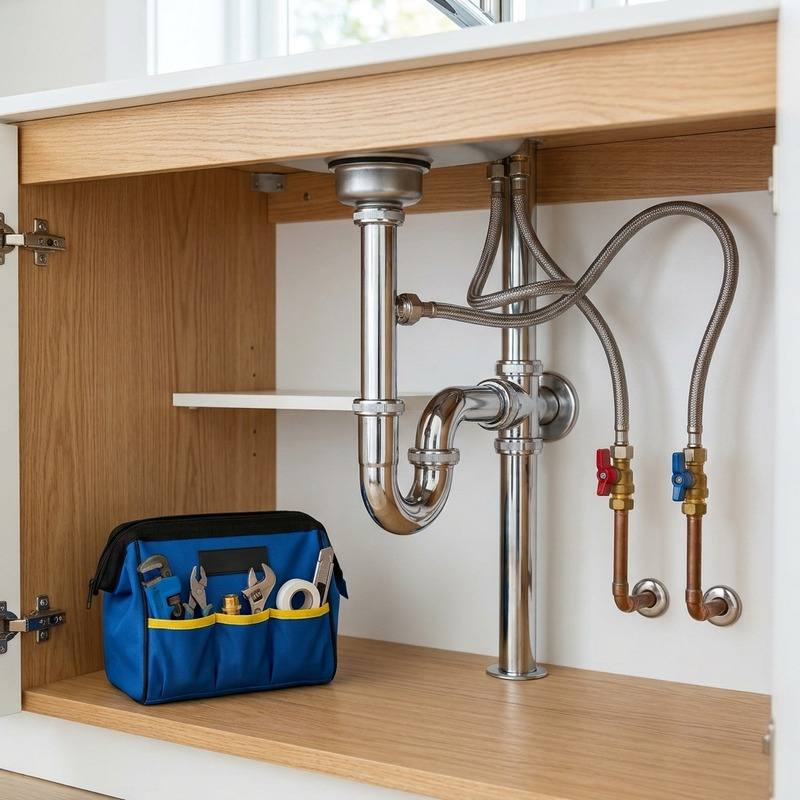
Flexible hoses deserve their own mention. The braided hoses under sinks and vanities are one of the most common causes of serious water damage in apartment buildings; they are inside the unit, and they are generally the owner’s to maintain and replace. They also fail without warning and at full mains pressure, which is why they are worth checking rather than forgetting.
Appliances connected to plumbing, such as a dishwasher or a washing machine and its connections, sit with the owner too.
One consequence worth understanding: where a fixture or hose inside your lot fails and water reaches the apartments below, the damage flowing from it can follow you rather than the owners corporation, which is where insurance arrangements start to matter.
Where it gets argued
Two situations account for most strata plumbing disputes, and both are arguments about facts rather than about the rules.
A leak inside a common wall affecting one lot. Water appears in your apartment, a stain spreads, and the source is somewhere inside the wall. Who pays depends entirely on which pipe is leaking: a branch line serving only your lot, or a stack serving the apartments above you. From the stain, nobody can tell. Both sides then argue from assumption, and the longer it runs, the more damage accumulates.
A blocked main stack that only backs up into one apartment. Drainage finds the lowest available outlet, so when a shared stack blocks, the overflow usually appears at the lowest fixture in the line rather than anywhere near the blockage. The apartment with water across the floor is often not the apartment with the problem. Treated as a single lot’s issue, the blockage stays where it is and the same apartment floods again a few weeks later.
A camera is what settles both. A CCTV drain camera inspection shows which line is involved, where the break or blockage sits, how far along the run it is and whether that run is shared. That footage turns an argument between a lot owner and a strata manager into a question with an answer, and it is also what insurers and strata committees act on when costs are allocated. Getting it done early is almost always cheaper than the dispute it prevents.
What to do first when a leak appears
The first hour matters more than people expect, mostly because of what it preserves for later.
- Isolate what you can. Shut off the stop tap for your lot or the fixture involved. If you cannot find it, call a plumber rather than going looking for the building’s main valve.
- Document everything. Photos and video with dates, where water is appearing, how quickly, and what has been damaged. Note the times. This is the record that supports any claim later.
- Notify the strata manager in writing. Phone as well if it is urgent, but put it in an email. Verbal notice tends to disappear at exactly the moment costs are being allocated.
- Get the line inspected before anyone opens a wall. This is the step most often skipped. Cutting into a wall first can destroy the evidence of where the water came from, and the cost of that decision tends to land on whoever made it.
- Keep damaged materials and receipts rather than clearing everything out, since insurers generally want to see them.
If what you have is a blockage rather than a leak, the same principle applies: blocked drain clearing in Sydney done with a camera on the line tells you whether the problem is on a shared run or yours alone, which decides who the invoice goes to.
Frequently Asked Questions
Who pays for a blocked drain in a strata building?
It depends on which line is blocked. A blockage in a shared stack or a common sewer line is generally the owners corporation’s cost, while a blockage in a branch line serving only your lot is generally yours. A camera inspection establishes which, before anyone is invoiced.
Is a leaking pipe inside my wall my responsibility?
Not necessarily. The question is what that pipe serves rather than where it sits. A pipe running inside your wall but serving several lots is generally common property, while a branch line serving only your apartment is generally yours. The registered strata plan and by-laws decide it.
Who is responsible for flexible hoses in an apartment?
Flexible hoses under sinks and vanities are inside the lot and are generally the lot owner’s responsibility to maintain and replace. They fail at full mains pressure and without warning, so checking them periodically is worth the few minutes it takes, particularly in older apartments.
The practical next step
If you are mid-argument, the useful move is to establish the facts rather than restate the rules. Find out which line is involved and where the fault sits, put that in writing to the strata manager, and read the by-laws alongside the registered plan before anyone commits to a position. Most strata plumbing disputes that drag on do so because nobody confirmed which pipe was actually involved at the start.
If you want this checked by a licensed plumber, Apex Plumbing Services works across Sydney 24 hours a day. Phone 1300 096 668.

