

Commercial Plumbing in Sydney: What Businesses Should Expect
Commercial plumbing is plumbing work on business, retail, industrial and strata properties, where the systems run at a larger scale than a home and carry compliance obligations such as backflow prevention, trade waste and gas certification. The work covers mains, hot water plant, drainage and fixtures across a whole building, usually with several tenancies affected at once.
Commercial plumbing is the work that keeps a building’s water, gas, drainage and hot water systems running for a business rather than a household. The difference is not only size. It is compliance, access, and the fact that an hour without water can close a kitchen, a clinic or a childcare room.
We work on commercial and strata properties across Sydney under NSW Licence 306733C, with more than 26 years behind it, including emergency plumbing across Sydney when something lets go mid-trade. What follows is what commercial plumbing actually covers, how a commercial job runs differently from a house call, the compliance obligations that sit with the property rather than with the plumber, and the questions worth asking before you engage anyone.
What commercial plumbing covers
Commercial plumbing covers the same four systems as a house, water, gas, drainage and hot water, built at a scale that changes how each one behaves.
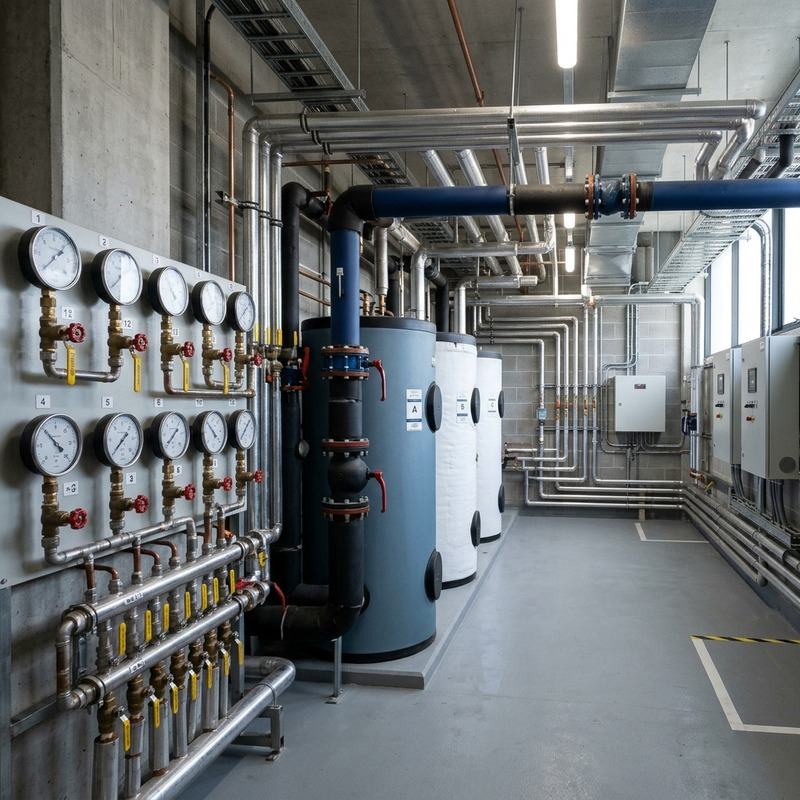
Pipe sizing and flow are the obvious part. A building serving dozens of fixtures at once needs larger mains, pressure management and often pump sets and multiple risers, none of which appear in a domestic job.
Trade waste is the part with no domestic equivalent at all. Food premises, workshops and manufacturing sites discharge wastewater that cannot go straight to sewer, so grease arrestors and other treatment equipment sit between the fixture and the connection, and they have to be sized, serviced and maintained.
Backflow prevention sits at the water connection and protects the mains from whatever is happening inside the property. Hot water is usually plant rather than a single unit: central systems, circulation loops and tempering valves serving an entire floor or building. Drainage runs to larger stacks, floor wastes and sumps.
The thread running through all of it is that downtime costs money. A failure in a house is an inconvenience. The same failure in a cafe or a medical suite stops trading, which is why commercial work is planned, staged and documented differently.
How a commercial job differs from a house call
The plumbing may be familiar, but almost everything around the work changes on a commercial site.
- Access takes planning. Plant rooms are locked, risers run through tenancies, and many sites require a site induction, a permit to work or an escort before anyone picks up a tool.
- Isolation affects other people. Closing one valve can take water from an entire floor or twenty units, so shutdowns need notice, a scheduled window and sometimes temporary supply.
- Trading hours drive scheduling. A great deal of commercial work happens at night, early morning or over a weekend, because that is the only time the space is empty.
- Paperwork is part of the job. Compliance certificates, test reports and updated records are deliverables in their own right, not an afterthought.
- A condition report matters before anyone starts. Knowing what state the existing system is in protects both sides, and it stops a pre-existing fault turning into an argument about who caused it.
That last point is worth paying for on an older building. Commercial systems are usually layered: original pipework, a refit from fifteen years ago, and whatever the last tenant added. A plumber who records what they found before touching anything gives you a baseline you can plan maintenance against, rather than a surprise every time something is opened up.
| Domestic job | Commercial job | |
| Access | Homeowner lets you in | Inductions, permits, keys, escorted plant room access |
| Scale | One dwelling, single fixtures | Multiple tenancies, risers, pump sets, plant |
| Compliance | Minimal paperwork | Certificates, test reports and lodgements |
| Scheduling | Business hours suit most jobs | Night, early morning or weekend around trading |
Compliance a Sydney business is responsible for
Several plumbing obligations sit with the property owner or occupier rather than with the plumber, and they continue whether or not anything is going wrong.
Backflow prevention. Sydney Water requires properties connected to its supply to have a testable backflow prevention containment device suited to the property’s hazard rating, and devices above low hazard to be tested each year by an accredited plumber, with the test report lodged with Sydney Water. The hazard rating depends on what happens on the site, so two neighbouring buildings can carry different requirements. Booking the annual backflow testing before it falls due is the simplest way to keep that obligation current.
Gas compliance. NSW Fair Trading requires a certificate of compliance for gasfitting work, issued by the licensed gasfitter who carried it out. Keep those certificates with the building records, because they are what you produce when a certifier, an insurer or an incoming tenant asks.
Trade waste. Sydney Water states that written permission is needed before trade wastewater is discharged into its systems, and that a service discharging without approval may be disconnected or restricted. If your site has a grease arrestor or any treatment equipment, the servicing frequency and the conditions attached to it come from that agreement.
What applies to your building depends on the property, the fixtures and the activity on site, so confirm your own position with Sydney Water or have your plumber check what is registered against the connection.
Planned maintenance versus reactive callouts
The cost of commercial plumbing is decided less by hourly rates than by whether work is scheduled or forced.
Drains make the clearest case. In a food premises, a planned jetting and camera inspection happens on a quiet morning, takes a known amount of time, and finishes before service. The same drain left alone blocks during a Friday dinner service, which means an after-hours attendance, a closed kitchen, a cleanup and the loss of the night’s trade. The plumbing work is similar either way. Everything around it is not.
Hot water plant behaves the same. Serviced on a cycle, wear is found while the system is still running and parts can be ordered. Left to fail, it fails completely and usually at the worst possible time, and a replacement unit is not something you source in an afternoon.
That is the argument for a maintenance schedule: it converts unpredictable, expensive interruptions into planned, quotable work. Reactive capability still matters, because pipes burst regardless, which is why emergency work exists at all. The point is to need it less often.
What to ask a commercial plumber before engaging them
A short list of questions separates a plumber set up for commercial work from one who mostly does houses.
Licence. Ask for the licence number and check that it covers the work you need, gasfitting included if gas is involved. Apex Plumbing Services holds NSW Licence 306733C.
Insurance. Ask what cover they carry and whether they can provide current certificates of currency, since most commercial sites and strata managers will want them on file before work starts.
After-hours availability. Ask what happens when something fails outside business hours, and who actually attends.
Compliance documentation. Ask whether they provide backflow test reports and lodge them, and whether gas certificates of compliance are issued as a matter of course. A plumber who treats documentation as optional creates a problem you only discover later.
Working around your trading hours. Ask whether they can stage work at night or over a weekend, and whether that is routine for them or an exception.
It is also worth asking who will be on site. Continuity matters on a building nobody has fully mapped.
Frequently Asked Questions
What is the difference between commercial and residential plumbing?
Commercial plumbing serves business, retail, industrial and strata properties, so systems are larger, serve many users at once and carry compliance obligations like backflow testing and trade waste. Residential work is smaller in scale, simpler to isolate and rarely involves lodged documentation or scheduled shutdowns across multiple tenancies.
Does a business need backflow testing every year?
Sydney Water requires testable backflow prevention devices above low hazard to be tested annually by an accredited plumber, with the result lodged with Sydney Water. The hazard rating of your property determines what device is required and how it is treated, so check what is registered against your connection.
Can commercial plumbing work be done outside trading hours?
Yes, and on many sites it is the normal way to work. Night, early morning and weekend scheduling keeps water and gas isolations away from trading, staff and customers. It needs planning, since access, inductions and notice to other tenancies all have to be arranged in advance.
The practical next step
If you manage a commercial building in Sydney, the useful starting point is knowing what you already have: what is on the connection, when the backflow device was last tested and lodged, whether gas certificates exist for the work done on site, and what condition the drains and hot water plant are actually in. That baseline tells you what needs scheduling and what can wait, and it turns plumbing from an unpredictable cost into a planned one.
If you want this checked by a licensed plumber, Apex Plumbing Services works across Sydney 24 hours a day. Phone 1300 096 668.

