



What Causes Blocked Drains, and How to Tell Which Drain Is Blocked
A blocked drain rarely arrives overnight. It builds, quietly, and the drain almost always warns you before it stops altogether, if you know what to listen and look for. The single most useful thing you can work out when a drain starts misbehaving is whether the problem sits at one fixture or in the shared line that serves several, because that one distinction changes everything about what happens next. This article walks through the common causes of blockages, the warning signs that come before a full stoppage, and a simple way to tell a local blockage at a single fixture from a main line blockage affecting the whole property. The aim is to help you understand what is happening, not to send you wrestling with it yourself.
Blocked drains are usually caused by what goes down them and what grows into them: fat and food waste in kitchens, hair and soap scum in bathrooms, wipes and foreign objects in toilets, and tree roots entering joints in older clay sewer lines. Collapsed or sagging pipe and poor fall cause repeat blockages.
What Actually Blocks a Drain
Blockages make the most sense when you look at them fixture by fixture, because that is how you actually experience them.
In the kitchen, the main culprits are fats, oils and greases. They pour down as a liquid and then cool on the pipe walls and solidify into a greasy film, and once that film is there, coffee grounds, rice, pasta and other food scraps lodge in it and build the blockage up layer by layer.
In the bathroom, it is hair. Hair binds with soap scum into a dense mat that catches across the waste and traps everything that follows, with toothpaste and skin oils adding to it over time.
In the toilet, the problems are wet wipes marketed as flushable, sanitary products, nappies and the occasional foreign object, none of which break down the way toilet paper does.
In the laundry, lint from washing and detergent residue gradually narrow the waste.
Then there are the external causes, which are often the more serious ones. Tree roots seek out the moisture and nutrients in sewer lines and work their way in at joints. Silt and leaf litter wash into gully and stormwater pits. And building debris or render left in the lines after renovation work can set hard inside the pipe. In each case, the material grips or catches rather than passing cleanly through, which is why a blockage grows instead of clearing itself.
The Warning Signs Before a Full Blockage
A drain usually moves through stages before it stops completely, and placing your own situation on that progression tells you how urgent it is.
Early on, you notice water draining more slowly than it used to, a brief swirl at the plughole before it clears, or a faint smell drifting up from the overflow.
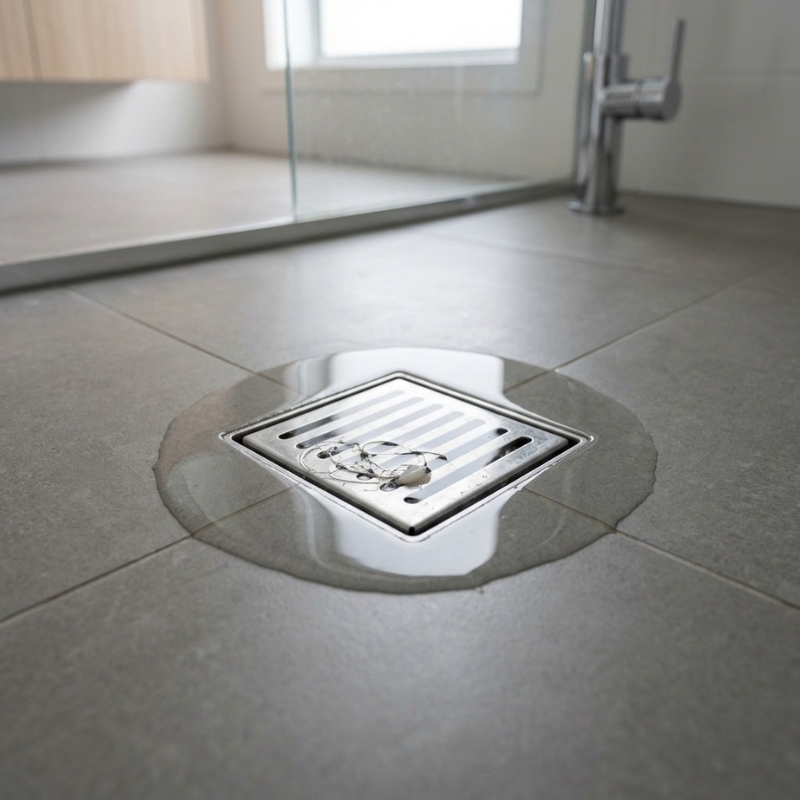
As it develops, the signs get harder to ignore: gurgling from a nearby fixture when another one drains, the water level in the toilet rising or dropping on its own, or water pooling around a shower waste that used to clear straight away.
When it is advanced, water backs up at the lowest fixture in the property, appears at an external gully, or affects several fixtures at once.
Of all these, gurgling is the most diagnostic single sign, so it is worth understanding. That gurgle is air being pulled through the water seal in a trap, because the line cannot drain or vent freely past a partial blockage. The draining water creates suction, and with nowhere to draw air normally, it pulls it through the nearest water seal, which is the sound you hear. In other words, a gurgle is the drain telling you there is a restriction further along, well before anything overflows.
One Fixture or the Whole Line? A Simple Test
Here is the single most useful thing to work out, and you can do it with no tools at all. Just pay attention to how many fixtures are affected and which ones.
- Only one fixture is slow, everything else runs normally. The blockage is most likely local, in that fixture’s own waste or trap. The problem is contained to that one spot.
- Two or more fixtures on the same branch are affected. If several fixtures served by the same branch of pipe are all slow or gurgling, the blockage is further along that shared branch rather than at any one fixture.
- The lowest fixtures back up, or water appears at an external gully. If water surfaces at an external overflow relief gully or backs up at the lowest fixtures in the property, the main line is involved.
That overflow relief gully is worth understanding, since it is doing its job when water appears there. Under the drainage standard AS/NZS 3500.2, it is designed as the point where a surcharging sewer spills outside at ground level rather than backing up inside the house through a floor waste or a toilet. So water at that grate is a deliberate safety feature working as intended, and it is a clear signal to stop. Once you see any backup, stop running water at every fixture, because continuing to add water to a line that cannot clear only pushes the overflow further.
Why Some Drains Block Again and Again
If a drain blocks, clears, and then blocks again at the same spot, the cause is almost never your habits. It is the pipe itself, and this is where a plunger was never going to be the answer. The structural causes sit beyond anything a household fix can reach:
- Tree root intrusion that grows back after being cut, because the roots keep returning to the moisture.
- A sag or belly in the pipe, where a section has dropped and solids settle in the low point instead of flowing through.
- Insufficient fall, where the grade of the pipe is too shallow to carry waste away properly.
- Offset or displaced joints, common in older vitrified clay lines that have shifted over time.
- Partial collapse of the pipe.
- Incorrectly graded or undersized sections added during a renovation.
The way these are found is a CCTV drain inspection, where a camera is run through the line to locate the fault and grade how serious it is. From there the options generally range across mechanical cleaning, high pressure water jetting, root cutting, pipe relining or sectional replacement, with the right one depending entirely on what the camera finds. Because locating the exact defect often overlaps with the equipment used for leak detection, the two are closely related skills. The key point is this: a blockage that keeps returning to the same spot is the strongest possible evidence of a structural fault, and it is exactly the situation that warrants proper blocked drain clearing in Sydney with a camera rather than another temporary clear.
What to Do and What Not to Do Right Now
If a drain is backing up, a few safe actions help while you arrange for it to be looked at:
- Stop using the affected fixtures, so you are not adding water the line cannot take.
- Clear a visible hair mat from a shower or basin waste if you can see and reach it.
- Remove leaf litter from an external grate that is obviously choked.
- Note which fixtures are affected and in what order they started, so that information is ready for whoever investigates.
Just as important is what not to do, because some common reactions make things worse:
- Avoid caustic drain chemicals. They can damage pipework, seals and fixtures, and they create a real hazard for anyone who has to work on the line afterwards, since the caustic liquid is still sitting in there.
- Do not keep plunging a toilet that is already full, which tends to force an overflow rather than clear anything.
- Do not force a hose into a line to try to flush it through.
- Do not lift inspection openings on a charged line, meaning one that is full and under pressure, because it can surge back.
It is worth knowing that drainage work in NSW is licenced work, which NSW Fair Trading sets the requirements for, so once a blockage is past a visible hair mat or a choked grate, it is a job for a licenced plumber. On the question of which section of the sewer is yours and which belongs to the authority, including the boundary trap and the main, Sydney Water is the body to confirm that with for your specific property, since it varies.
Frequently Asked Questions
Why does my sink gurgle when the washing machine drains?
That gurgle is air being pulled through a water seal because the shared line cannot drain or vent freely. It usually means a partial blockage further along the branch that both the sink and the washing machine feed into, rather than a problem at the sink itself.
Are flushable wipes safe for drains?
Not really. Wipes do not break down the way toilet paper does, so they stay intact and snag on joints, tree roots and existing build-up inside the line. That is why they are a common cause of blockages in both residential and commercial drains, despite the label.
What does water at my outside drain grate mean?
Water surfacing at an overflow relief gully means the system is spilling outside by design, because the line below it cannot take the flow. It indicates a main line blockage, and fixtures should not be used until it has been investigated, since more water only adds to the overflow.
Can tree roots really get into sewer pipes?
Yes. Roots follow moisture and work their way into fine cracks or gaps at pipe joints. Once inside, they keep growing in the flow and trap solids passing through, which is why blockages recur at the same point until the underlying pipe defect itself is repaired.
Working out what your drain is telling you
The diagnostic rule is worth remembering: one slow fixture is usually a local blockage, several on the same branch means it is further along that line, and backup at the lowest fixtures or water at an external gully points to the main line. And a blockage that keeps returning to the same spot points to a structural fault in the pipe rather than anything you are doing. If a drain is backing up, gurgling or blocking repeatedly, our licenced Sydney plumbers can locate the cause with a camera inspection and clear it properly. Contact Apex Plumbing Services about blocked drains at your property.

