


Where Is Your Water Stop Tap, and How to Use It
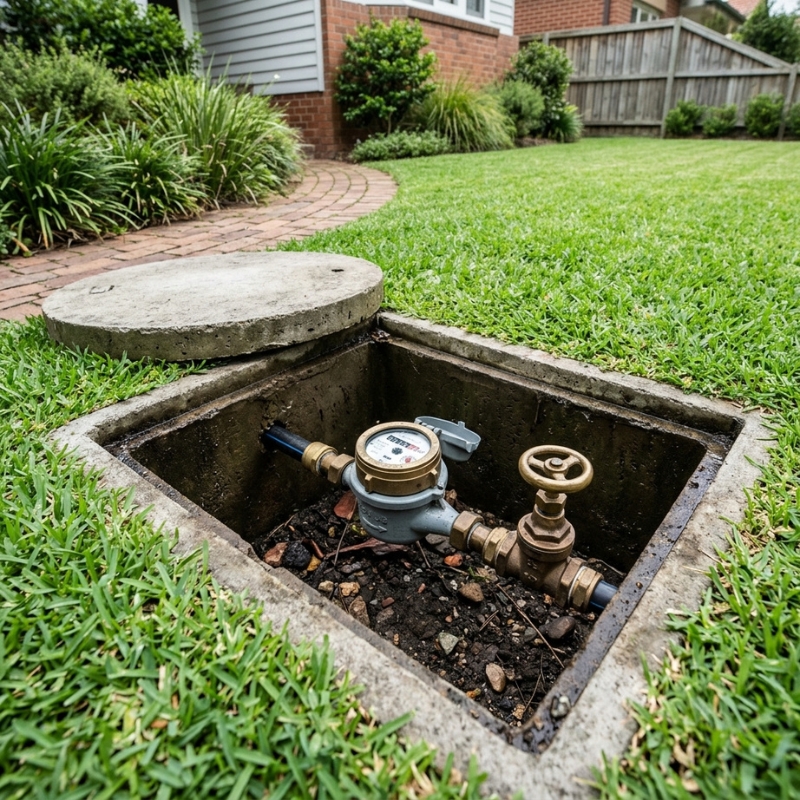
A stop tap is the valve that shuts off the water supply to your property. On most Sydney homes, it sits in the water meter box near the front boundary, on the house side of the meter. Turning it clockwise until it stops closes the supply to the whole property.
Your stop tap is almost certainly in the water meter box near your front boundary, and turning it clockwise shuts the water off to the whole property. That one valve is the difference between a wet patch and a flooded house, and most people go looking for it for the first time while water is already running.
Apex Plumbing Services works across Sydney under NSW Licence 306733C, with more than 26 years behind it, and whether you have found that valve is the first thing our emergency plumbers in Sydney ask when a call comes in at 2 am. What follows is where to find yours, how to turn it off without damaging it, what to do once the water stops, and what it means if the tap itself is dripping.
Find it before you need it
Go and look now, while nothing is wrong. It takes two minutes, and it is far easier than searching with water coming through a ceiling.
On most Sydney properties, the stop tap is in the water meter box near the front boundary, usually a rectangular plastic or concrete box set into the lawn or garden, sometimes with a lid that needs lifting rather than unscrewing. Inside, you will see the meter, with a tap on either side of it. The one on the house side of the meter is the one you want.
Many properties also have a second isolation valve closer to the house, often on an external wall near where the supply enters, by the laundry, or near the hot water unit. In a townhouse or a unit, there is usually an isolation valve for your dwelling alone, sometimes in a cupboard, a riser or a shared meter bank.
If the box is buried under grass, mulch or a shrub that has grown over it, clear it now. A valve you cannot reach is a valve you do not have.
How to turn it off
Turn it clockwise, which is to the right, and keep turning until it stops.
Most older stop taps are a screw-down type with a round handle, and they need several full turns to close completely. Half closed is not closed, so keep going until the handle will not move easily any further, then stop. Do not haul on it once it has seated.
Newer installations often use a quarter-turn ball valve with a lever handle instead. Those are simpler: when the lever lies in line with the pipe, the valve is open, and when it sits across the pipe, it is closed. One quarter turn does the whole job.
If the tap is stiff, work it gently back and forth rather than applying everything you have. These valves are brass, and they sit in the ground for decades without being touched, so they seize. The failure mode matters: a seized tap that shears off leaves you with an open water main you cannot close, which is a much worse afternoon than the one you started with. Do not use a wrench or a lever bar for extra leverage.
If it will not budge, stop and call a plumber. If water is actively escaping and the valve will not close, say exactly that when you call, because it changes how the job is treated.
Once it is off, check a tap inside the house to confirm the flow has actually stopped rather than assuming it has.
What to do once the water is off
With the supply closed, open the lowest tap in the house, usually a laundry tub or an outside garden tap, and let the remaining water in the pipes drain out. That takes the pressure off and reduces what keeps escaping from the fault.
Then photograph everything before you start cleaning up. Photograph where the water is coming from, how far it has spread, the ceiling, the flooring, any damaged contents, with the date on the files. Insurers want that record, and it is almost impossible to reconstruct afterwards.
Switch off power at the board if water is anywhere near electrical fittings, lights or outlets, and keep clear of a wet ceiling that is sagging.
Then call a plumber. If a pipe has let go rather than a fitting dripping, that is burst pipe repairs in Sydney territory and the main stays off until it is fixed. Mention on the phone that the water is already isolated, since it tells the plumber the situation is contained and what they are walking into.
If your stop tap itself is dripping or will not seal
A dripping stop tap is a repair rather than an emergency, but it needs sorting, because the moment you need that valve is the moment you find out it no longer seals.
First, work out which tap is dripping, because ownership splits at the meter. Sydney Water’s position is that the meter and the supply up to it are theirs, while the pipework and fittings on the property side of the meter belong to the owner. In practice, that means a problem on the street side of the meter is one to report to Sydney Water, while the tap on the house side is yours to have repaired.
The usual causes are age and lack of use. The washer or seal inside hardens over the years, grit works into the seat, or the spindle packing lets go, and water weeps out around the handle rather than past the valve. Most of these are repairs rather than replacements, though a corroded body or a tap that has been forced usually needs changing.
What matters more than the drip is what it signals. A valve that no longer seals properly will not hold back a full main when you ask it to, which you will discover at the worst possible moment. If yours weeps, will not close fully, or feels like it is about to snap, have it replaced while nothing is urgent.
A two-minute check worth doing today
Four things, and none of them need tools.
- Locate it. Open the meter box and identify the tap on the house side of the meter.
- Clear access to it. Cut back whatever has grown over the box and make sure the lid lifts.
- Test that it turns. Close it, check a tap inside has stopped, then open it fully again. If it is stiff or weeping, book a plumber now rather than later.
- Tell everyone in the house. Including anyone who house-sits, and in a rental, make sure whoever lives there knows, not only the landlord.
Frequently Asked Questions
Which way do you turn a stop tap off?
Clockwise, to the right. A screw-down tap with a round handle takes several full turns to close properly, so keep going until it stops. A quarter-turn lever valve closes in one quarter turn, and sits across the pipe when closed. Check a tap inside to confirm the flow has stopped.
Why is my stop tap dripping?
Usually age or lack of use. The internal washer hardens, grit lodges on the seat, or the packing around the spindle fails and water weeps past the handle. It is a repair rather than an emergency, but a valve that no longer seals will not hold back the main when you need it to.
Who is responsible for the tap at the water meter?
Sydney Water’s position is that the meter and the supply up to it are theirs, while pipework and fittings on the property side of the meter are the owner’s. So a fault on the street side goes to Sydney Water, and the tap on the house side is the property owner’s to repair or replace.
The practical next step
Do the two-minute check this week rather than next. Find the valve, clear the box, turn it off and on once to prove it works, and tell the rest of the household where it is. If it is seized, weeping or you cannot find it at all, that is worth sorting now while it costs you an appointment rather than a ceiling.
If you want this checked by a licensed plumber, Apex Plumbing Services works across Sydney 24 hours a day. Phone 1300 096 668.

