


Why Hot Water Is Stored at 60°C but Delivered at 50°C
In Australia, stored hot water is kept at or above 60°C to stop Legionella bacteria growing in the tank, while water delivered to bathroom taps, showers and baths is limited to 50°C to prevent scalding, or 45°C in aged care and similar facilities. A tempering valve bridges the two temperatures.
Your hot water is stored at around 60 degrees and should arrive at the bathroom tap at no more than 50. That is not an inefficiency or a fault; it is two separate safety problems being solved at once: bacteria in the tank at one end, and scalding at the tap at the other.
We work on hot water systems in Sydney under NSW Licence 306733C, with more than 26 years behind it. What follows is why the tank has to be hot, why the tap has to be cooler, the small valve that sits between the two, and how to tell when that valve has stopped doing its job.
The two numbers
Two requirements pull in opposite directions, and both have to be met at once.
At the storage end, the National Construction Code’s Plumbing Code of Australia requires heated water to be stored and delivered under conditions that avoid the growth of Legionella bacteria, and AS/NZS 3500.4 sets the delivery temperature from a water heater or storage vessel at not less than 60 degrees.
At the fixture end, the same Code limits the delivery temperature at the outlet of sanitary fixtures used primarily for personal hygiene to no more than 50 degrees, and to no more than 45 degrees in settings such as aged care. AS/NZS 3500.4 applies the lower figure to early childhood centres, primary and secondary schools, nursing homes and similar facilities.
Personal hygiene fixtures mean baths, showers and basins. Kitchen sinks and laundry troughs are not subject to those delivery limits.
Why the tank has to be hot
Stored water is the problem that the 60-degree figure exists to solve.
A tank holds a large volume of water that can sit for hours or days without moving. Warm, still water is the condition in which Legionella bacteria can multiply, and that bacteria is the reason the Code frames the requirement around avoiding conditions that let it grow rather than around how hot you like your shower.
Held properly hot, the tank simply does not offer those conditions. Held lukewarm, it can. That is why the storage figure is a minimum rather than a target, and why winding a thermostat down to shave a little off running costs is a trade not worth making. The same applies to a failing thermostat or a struggling element quietly letting storage temperature drift below where it should be, which is not something you notice at the tap.
Places where water sits unused for long stretches deserve a thought too, such as a holiday house, a rarely used ensuite or an outlet nobody turns on. Water that never moves is water that never gets replaced.
Why the tap has to be cooler
At the other end of the system, the risk changes completely. It is no longer about what grows in the water; it is about what the water does on contact.
Scald severity rises steeply with temperature, and the margin for reacting shrinks fast. Victorian Building Authority guidance illustrates the difference plainly: at 50 degrees a full thickness scald takes up to five minutes, while at 68 degrees it can take as little as one second. The gap between those two numbers is the whole reason a delivery limit exists.
Who is at risk matters as much as the temperature. Small children have thinner skin, react more slowly, and often cannot pull themselves out of a bath or reach a tap to turn it off. Older people, anyone with reduced sensation in their hands or feet, and anyone with limited mobility face the same problem for different reasons. In all of those cases, the injury happens in the time it takes to realise something is wrong.
That is also why the lower 45-degree limit applies where it does, in facilities serving people least able to react quickly.
Worth saying plainly: 50 degrees is still hot. The limit is not about a cooler shower; it is about removing the few seconds in which serious injury happens.
The device that bridges the two
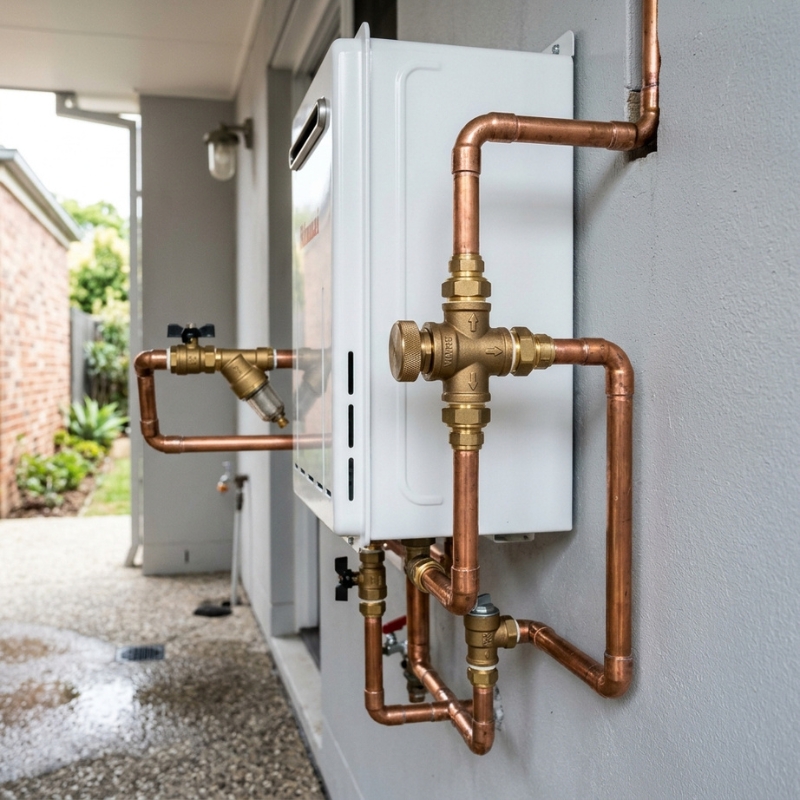
A tempering valve is what makes both requirements possible at the same time. It blends stored hot water with cold water to deliver a controlled temperature at the fixture, so the tank stays at 60 while the shower arrives at 50.
It is a small brass body with three connections, fitted on the outlet side of the hot water unit, usually within easy reach of it. AS/NZS 3500.4 requires tempering valves to be readily accessible, which is why yours should not be buried behind anything. A thermostatic mixing valve is the higher specification valve used where the 45-degree limit applies, and tighter control is required.
It is also a mechanical device with a service life. Inside sits a temperature-sensitive element that opens and closes against the hot and cold inlets thousands of times, and it wears. Scale, grit and debris from the water supply build up around the moving parts. Eventually the blend drifts, or the valve stops responding altogether.
Manufacturers set their own servicing and replacement intervals for the valve they made, so the right figure is the one on your unit rather than a rule of thumb. What matters is knowing the valve is not permanent, since the protection it provides disappears quietly rather than announcing itself, and tempering valve replacement in Sydney is a straightforward job compared with what a failed valve can allow through to a tap.
Signs yours has failed
A failing tempering valve usually shows up as temperature behaving oddly rather than as an outright breakdown.
The common signs are water that is suddenly too hot at a basin or shower while the kitchen tap seems normal, water that is never hot enough no matter how long you run it, temperature that swings during a shower, or a noticeable difference between one bathroom and another in the same house.
Any of those is worth having checked rather than ignored, particularly the first one. A valve letting water through hotter than it should is a scald risk sitting in the wall, and nobody in the house gets a warning.
Setting a tempering valve is licensed work, so the fix is a measured test at the fixture rather than a turn of the cap.
Frequently Asked Questions
What temperature should hot water be in Australia?
Stored hot water is kept at not less than 60 degrees under AS/NZS 3500.4 to avoid conditions where Legionella can grow. Water delivered to baths, showers and basins is limited to 50 degrees under the Plumbing Code of Australia, or 45 degrees in aged care, schools, early childhood centres and similar facilities.
Why is my shower lukewarm when the kitchen tap runs hot?
Because only the personal hygiene fixtures are tempered. The kitchen sink is not subject to the delivery limit, so it draws closer to storage temperature. A lukewarm shower alongside a hot kitchen tap often points to a tempering valve that has drifted or failed rather than to the hot water unit itself.
How often does a tempering valve need replacing?
That depends on the valve, since manufacturers set their own servicing and replacement intervals for their products. What is consistent is that these valves wear, with scale and debris affecting the moving parts over time, so the interval on your unit is the one to follow rather than any general figure.
The practical next step
If the temperature at your taps has changed, in either direction, the useful move is to have it measured at the fixture rather than adjusted by feel. A plumber can check what the storage temperature actually is, what is arriving at the bathroom outlets, and whether the tempering valve is still holding the blend it was set to. That takes the guesswork out of it, and in a house with small children or an older relative, it is worth knowing rather than assuming.
If you want this checked by a licensed plumber, Apex Plumbing Services works across Sydney 24 hours a day. Phone 1300 096 668.

