













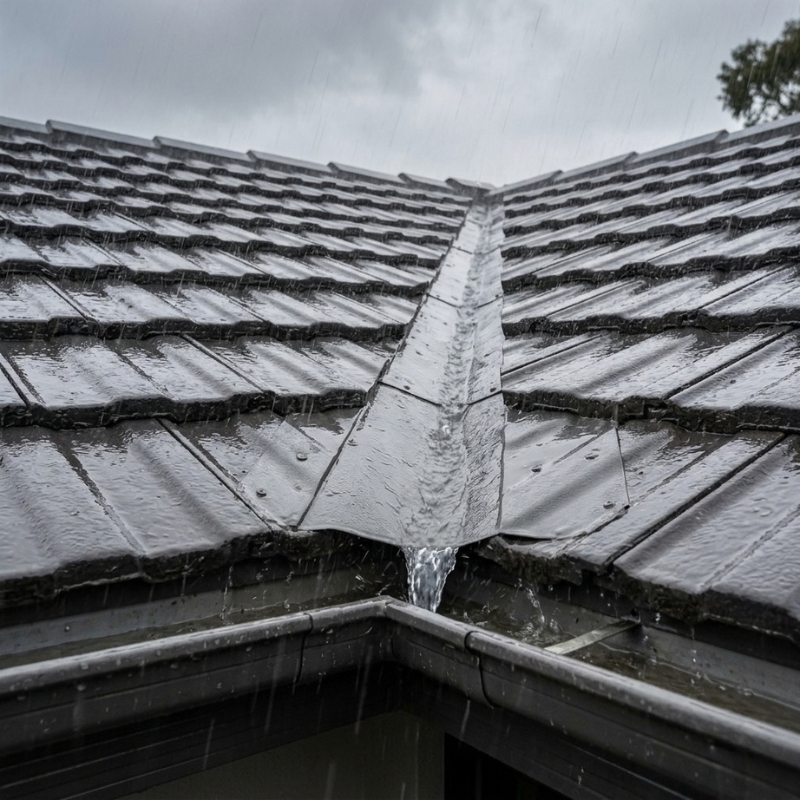
Why Roofs Leak in Heavy Rain: Flashings, Valleys and Box Gutters
You have probably noticed the pattern: the roof is perfectly fine in ordinary rain, and only leaks when it really buckets down, or only when the wind drives the rain in from one particular direction. That pattern is not random, and it is actually good news in a way, because it tells you the roof covering itself is most likely intact. The problem is almost certainly at a junction, a drainage path, or a point where capacity gets overwhelmed. This article walks through the usual entry points, why rain volume and wind direction change everything, and why the stain on your ceiling is rarely sitting directly below where the water is getting in.
A roof that only leaks in heavy rain usually has a drainage or junction problem rather than a hole. Flashings, valleys and box gutters can cope with ordinary rain but overflow, back up or let wind-driven water past once volume and pressure rise. The covering itself is often sound.
Flashings and Penetrations: The Usual Suspects
Most roof leaks happen exactly where the roof stops being a plain, continuous surface. Anywhere the roof is interrupted is a potential entry point: wall and parapet abutments, chimneys, skylights, vent pipes, aerials, the mounting feet of solar panels, and the apron where a lower roof meets a wall.
A flashing is the piece that bridges one of these junctions, directing water back out onto the roof surface so it cannot get in at the gap. When a flashing fails, it tends to fail in one of a few predictable ways: sealant used as a shortcut instead of a properly lapped flashing, a flashing with too little upstand or no proper chase cut into the wall, edges that have lifted or splayed after wind, corrosion along the fold line where the metal is worked hardest, and fixings that have gradually backed out.
Here is why so many of these only leak in heavy rain. In light rain, the water running across the roof is shallow, and it never rises high enough to reach the top of the flashing upstand or get behind a slightly lifted edge. Let the rain get heavy, or let the wind drive it upward against the junction, and the water depth and pressure both climb until it reaches the weak point and gets past. The junction was always marginal; the heavy rain is just what exposes it.
Valleys, Gutters and Downpipes: It Is a Capacity Problem
Roof drainage is designed to handle a certain rainfall intensity, and the standards that govern how gutters and downpipes are sized for that, AS/NZS 3500.3, exist precisely because once you exceed the capacity the system was built for, the water simply goes where it was never meant to. A capacity problem does not announce itself until the rain is heavy enough to find it.
A few things go wrong here. Valley gutters, the channels where two roof planes meet, silt up with leaf litter and debris, and once the channel is partly choked the flow is forced sideways, under the tiles or sheeting on either side. Eaves gutters overflow backwards: when a downpipe is blocked or undersized, water that cannot escape fast enough rises in the gutter and spills over the back edge, behind the fascia and into the eaves rather than safely over the front. And a gutter that has sagged or lost its fall lets water stand in the trough, where it sits and corrodes the metal from the inside.
Blocked downpipes and stormwater lines are often part of the same story, since a roof cannot drain faster than the pipes below it can carry the water away, and clearing blocked drains in the stormwater system is sometimes what a “roof leak” actually needs. Gutter guard can genuinely help keep debris out, but a poorly installed guard can also hold leaf litter up above the trough, which is its own problem.
Box Gutters and Flat Roofs Fail Differently
Box gutters deserve particular attention, because they are the highest-consequence drainage element on a lot of Sydney commercial buildings and renovated homes. Unlike an eaves gutter on the edge of the roof, a box gutter sits within the roof structure itself. So when it overflows, the water discharges inside the building, into the ceiling and down the walls, rather than spilling harmlessly over an edge.
A box gutter depends on three things working together: the sump (the low collection point), the outlet that drains it, and an overflow provision as a backup, all of which the National Construction Code and AS/NZS 3500.3 set requirements for. The common failures track those parts. Debris collects at the sump and chokes it, the outlet is undersized for the area of roof draining into it, there is no functioning overflow when the main outlet is overwhelmed, the gutter has insufficient fall to move water to the outlet, or the joints and membrane in the sole of the gutter have failed.
Flat and low-pitch roofs fail in related ways. Water ponds where it should drain, sitting on the surface rather than running off. Laps and terminations fail, and penetrations move and open up. Because none of this is visible or judgeable from the ground, these roofs really need to be inspected on a schedule rather than left until a stain appears.
Tile and Metal Roofs: Different Entry Points
The two most common roof types fail through genuinely different entry points, so it is worth knowing which applies to yours.
Tile roofs leak through slipped, cracked or chipped tiles, failed mortar bedding and pointing along the ridges and hips, and broken or missing sarking (the membrane beneath the tiles). There is also a subtler one: in wind-driven rain, capillary action can draw water sideways between tiles that are sitting perfectly in place. That is why a tile roof can leak even when every tile looks intact from the outside, which catches a lot of people out.
Metal sheet roofs have their own list. Corrosion often starts at the cut edges of the sheet. Fastener washers perish with age, or were overdriven on installation so the sheet is dished around the screw and holds water. End laps with too little overlap let water track back up under capillary action and wind. A pitch too shallow for the particular sheet profile lets water sit rather than run. And sealant at the turn-ups eventually fails.
One failure mode affects both: mixing dissimilar metals accelerates corrosion where they meet. And on either roof type, a leak that is new on an old roof very often traces to something installed later, an aerial, an air conditioner, a solar array, that penetrated the roof without being flashed properly. If your metal roof is the culprit, proper metal roof leak repairs in Sydney address the actual entry point rather than just coating over it.
Why the Stain Is Not Below the Leak
Here is the thing that makes roof leaks so frustrating to chase: the stain on your ceiling is almost never directly below where the water got in. Once water penetrates the roof, it does not drop straight down. It runs along the underside of the sarking, down a rafter or a batten, along the length of a truss or even a cable, and only falls when it reaches the first low point or obstruction, which can be metres from the actual entry point.
This is exactly why pushing on a stain, or cutting the ceiling open beneath it, so rarely finds the source. The stain marks where the water left the structure, not where it came in. Proper diagnosis works from the roof and the roof cavity downward, with the rain conditions in mind, often using moisture mapping and the same tracking logic as leak detection to follow the water back to its origin.
You can help enormously by recording a few things when it leaks: when it happens, how heavy the rain was, which direction the wind was coming from, which room, how long after the rain started the stain appeared, and crucially whether it keeps going after the rain stops. A leak that continues after the rain has eased suggests a reservoir somewhere, a blocked gutter or ponding water slowly draining through, rather than direct entry. One safety note: do not go up onto a wet roof to investigate.
Frequently Asked Questions
Why does my roof only leak in heavy rain?
Light rain stays within the drainage capacity and sits below the flashing upstands, so it drains away normally. Heavy or wind-driven rain overwhelms the gutters and pushes water past junctions it would never reach otherwise, which is why a roof with a sound covering can still leak once the volume and pressure rise.
Can I just seal a roof leak with silicone?
Sealant over a drainage or flashing fault only hides the symptom, and it usually fails again at the next bit of movement or the next heavy downpour. The junction, lap or outlet itself needs to be corrected so the water is directed away properly, rather than relying on a bead of sealant to hold it back.
Why is the water stain not directly under the hole?
Because water tracks along the sarking, rafters, battens and even cables before it drops at the first low point it reaches. So the stain marks where the water finally left the structure, not where it entered, which is exactly why the roof and the cavity are inspected rather than the ceiling beneath the mark.
Is a leaking box gutter more serious than a leaking eaves gutter?
Generally yes. A box gutter sits inside the roof structure, so when it overflows the water discharges into the building rather than over an edge the way an eaves gutter does. That is why its sump, outlet and overflow provision are checked particularly carefully when a leak is being traced.
Reading the pattern of the leak
The pattern tells you most of what you need to know. A leak that depends on heavy rain or wind direction points to a junction or a drainage capacity problem rather than a hole in the roof, the ceiling stain is where the water left the structure rather than where it entered, and writing down the conditions each time it leaks genuinely shortens the hunt for the source. If your ceiling stains every time it pours, our licenced Sydney plumbers can inspect the flashings, valleys and box gutters and carry out the roof repair properly. Contact Apex Plumbing Services about leaking roof repairs.

