




How Water Filters Work: Sediment, Carbon and Membrane Stages Explained
When most people start shopping for a water filter, they ask which brand is best. It is the wrong first question. The one that actually matters is what each stage of a filter physically does, and in what order, because a filter is not a single thing, it is a sequence of physical and chemical steps. Get the sequence right and each stage does its job and protects the next. Get it wrong and you either get disappointing water or cartridges that clog far too early. By the end of this article you will understand what sediment, carbon and membrane stages each do, the difference between treating one tap and treating the whole house, and how to recognise a cartridge that is spent.
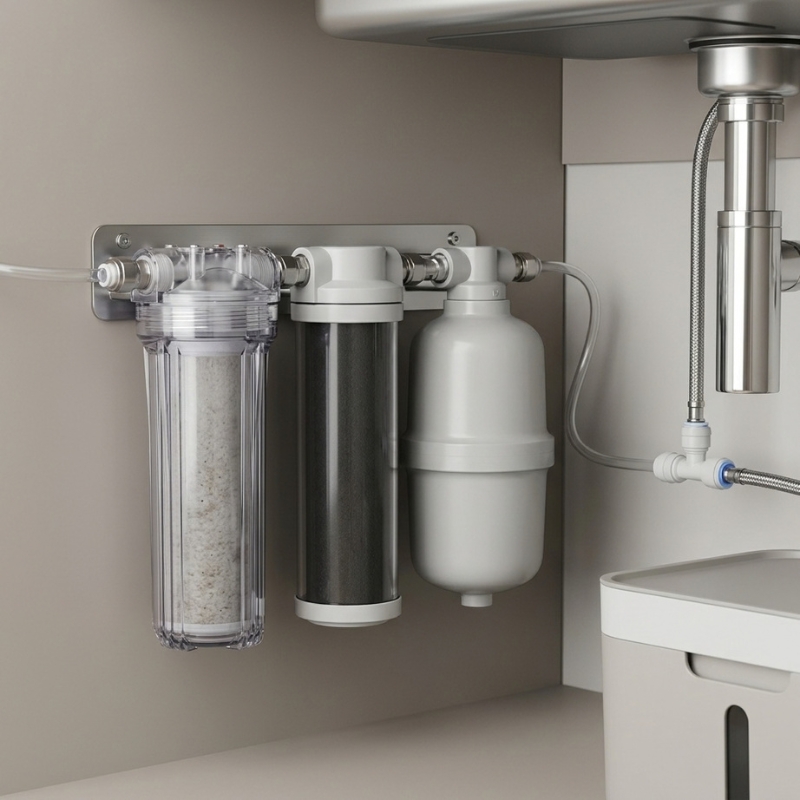
Water filters work in stages. A sediment filter traps particles by size, measured in microns. An activated carbon stage adsorbs chlorine, taste and odour compounds onto a huge internal surface area. A membrane stage, where fitted, rejects dissolved substances. Each stage protects the next and has a finite capacity.
Stage One: Sediment Filtration and Micron Ratings
The first stage in almost any filter is mechanical straining, which is exactly what it sounds like. A pleated or spun polypropylene cartridge physically holds back any particle larger than its pore size, letting the water through and catching the grit. The micron rating is simply the measure of that pore size: it describes the size of particle the cartridge is designed to stop.
There is a distinction worth knowing between a nominal and an absolute rating. A nominal rating means the cartridge captures most particles of that size, while an absolute rating is a stricter guarantee that it captures essentially all of them. The construction matters too: a graded-density cartridge, which is denser toward the centre, loads up with particles more evenly through its depth, whereas a simple surface filter catches everything on its face and blocks sooner.
The practical trade-off is the key thing to understand. A finer filter gives you clearer water, but it also blocks up faster and drops your water pressure sooner. This is why sediment filtration is almost always placed first in the sequence: it protects the more expensive and delicate carbon and membrane stages downstream from being clogged by grit. In older plumbing in particular, rust and pipe scale are realistic sources of particulate, so the sediment stage often has real work to do.
Stage Two: Activated Carbon and What Adsorption Actually Is
The second stage is usually activated carbon, and it works on a completely different principle from the sediment filter. Carbon does not strain particles out, it uses adsorption, which is worth getting right because people often confuse it with absorption. Absorption is soaking in, the way a sponge takes up water. Adsorption is sticking to a surface, the way dust clings to a surface. Contaminants in the water stick to the surface of the carbon rather than soaking into it.
What makes this effective is that activated carbon has an enormous internal surface area, a vast network of tiny pores, so a small cartridge presents a huge area for contaminants to stick to and can therefore treat a large volume of water.
There are two common forms. Granular activated carbon is loose media that allows a higher flow rate, but water can sometimes channel through it, finding paths of least resistance and getting less contact. A carbon block is compressed solid, which gives more contact time and also does some mechanical filtering of its own. Contact time is the concept underneath both: the longer the water is in touch with the carbon, the more it can adsorb, which is why pushing water through too fast reduces performance. Carbon is very good at chlorine, taste, odour and many organic compounds, but it is not a universal filter that removes everything. What any given carbon product is certified to reduce is defined by its certification to AS/NZS 4348 or the NSF/ANSI standards, which is the reliable guide rather than any blanket claim.
Membranes and Specialist Media
Beyond carbon, some systems add a membrane stage for finer treatment. Ultrafiltration is a very fine physical barrier, straining out things far smaller than a sediment filter can. Reverse osmosis (RO) goes further again: it is a pressure-driven membrane that rejects dissolved salts and other dissolved substances. Because RO separates the water into treated water and a concentrated reject stream, an RO system needs a drain connection to send that reject away, along with a storage tank, since it produces treated water more slowly than it is drawn. RO also typically needs pre-filtration ahead of it to protect the membrane, and sometimes a post-carbon polishing stage after it.
Then there are specialist media, chosen for specific problems rather than fitted as standard. KDF and catalytic carbon are used for chloramine, ion exchange addresses hardness or specific unwanted ions, and ultraviolet (UV) is a disinfection step that treats the water with light rather than filtering anything out of it. The important principle with all of these is that they are selected against a known water analysis, not guessed at, because the right media depends entirely on what is actually in the water. This matters most where the supply is not mains water, such as filtering from rainwater tank systems, where an analysis of the specific water guides the whole design.
Point-of-Use, Point-of-Entry and Fridge Filters
Where a filter is installed matters as much as what is inside it, and there are three main placements.
A point-of-use filter sits under the sink and treats a single outlet, usually a dedicated filtered tap or a three-way mixer. This is the usual choice for drinking and cooking water, since it treats the water you actually consume without treating everything else.
A point-of-entry, or whole-house, filter treats all the water entering the property, including showers and laundry. Because it handles everything, it has to be sized for the property’s peak flow so it does not choke your water pressure when several outlets run at once, and it needs to be mounted somewhere it can actually be reached for servicing.
Inline fridge and ice-maker filters are small-capacity carbon cartridges that treat the water going to the fridge. They need their own isolation valve and a correctly rated connection, and this is where connection method genuinely matters, because a leak at a fridge filter happens behind the appliance where you will not see it until there is damage. We have covered that particular setup in detail in our guide to fridge water filtration, so rather than repeat it here, the point is that whichever placement suits you, it is worth having a plumber install a water filter so the connection and isolation are done properly.
How to Tell a Cartridge Is Spent
Rather than relying on the calendar, it helps to know the observable signs that a cartridge has done its work:
- Noticeably reduced flow at the filtered outlet, the most common sign a sediment cartridge is loaded up.
- Chlorine taste or smell returning, which means the carbon is no longer adsorbing it.
- Cloudiness or grit appearing in the filtered water.
- A visibly discoloured or deformed sediment cartridge when you inspect the housing.
- A pressure drop across a housing, if yours has gauges fitted to show it.
- For RO, a slow refill of the storage tank or a change in the taste of the water.
There is one catch worth flagging: carbon gives no visual warning when it is exhausted. A carbon cartridge that is completely spent looks exactly like a fresh one, which is precisely why the manufacturer’s rated capacity and keeping a record of your last change-out matter so much. The other thing a proper change-out involves is hygiene: the housings and O-rings are cleaned and the seal renewed when the cartridge is swapped, not just the cartridge dropped in. As for timing, the right guide is the manufacturer’s rated capacity for your system and usage rather than a fixed number of months.
Frequently Asked Questions
What does a micron rating actually mean?
It describes the size of particle a cartridge is designed to hold back, measured in microns. A lower number means finer filtration, catching smaller particles. The trade-off is that finer cartridges clog faster and can reduce your flow, which is why the sediment stage is matched to the water and the system rather than simply made as fine as possible.
Does a carbon filter soften water?
No. Carbon works by adsorption, which improves taste and odour and removes chlorine and many organic compounds, but it does not remove the hardness minerals that make water hard. Hardness is a separate problem, addressed with ion exchange or a dedicated conditioning stage that is selected against an analysis of your actual water.
Do I need an undersink filter or a whole-house filter?
An undersink unit treats drinking and cooking water at one outlet, while a whole-house unit treats every outlet in the property and has to be sized for peak flow so it does not reduce pressure. The right choice depends on what you want to treat and the space available where the system would be installed.
How do I know when to change my water filter cartridge?
The practical signs are reduced flow, a returning chlorine taste or odour, and visible discolouration in the water or on a sediment cartridge. Carbon is the exception, since it can be exhausted with no visual change at all, so the manufacturer’s rated capacity and a record of your last change should guide replacement.
Getting the sequence right
Filtration is a sequence: strain out the particles first, adsorb the chlorine, taste and odour with carbon next, and only then add a membrane or specialist media if a water analysis actually calls for it. Alongside the cartridge choices, correct sizing and a location you can service matter just as much to whether the system works well over time. If you want filtered water at the kitchen, the whole house or a fridge and ice maker, our licenced Sydney plumbers can specify, install and service the right system. Contact Apex Plumbing Services about water filter installation.

