




Storage or Continuous Flow: How Each Hot Water System Heats Your Water
The choice in front of you comes down to two very different ideas. One system stores a tank of heated water and holds it ready for when you want it. The other heats water only as it flows, the moment you open a tap. They perform differently and they fail differently, and understanding the mechanism behind each explains almost every complaint people have about hot water: running out halfway through a shower, lukewarm water when the tap is barely open, a long wait for hot water to reach a distant outlet. This article walks through how each type actually heats your water, so you finish able to match a system to the way your own household uses it.
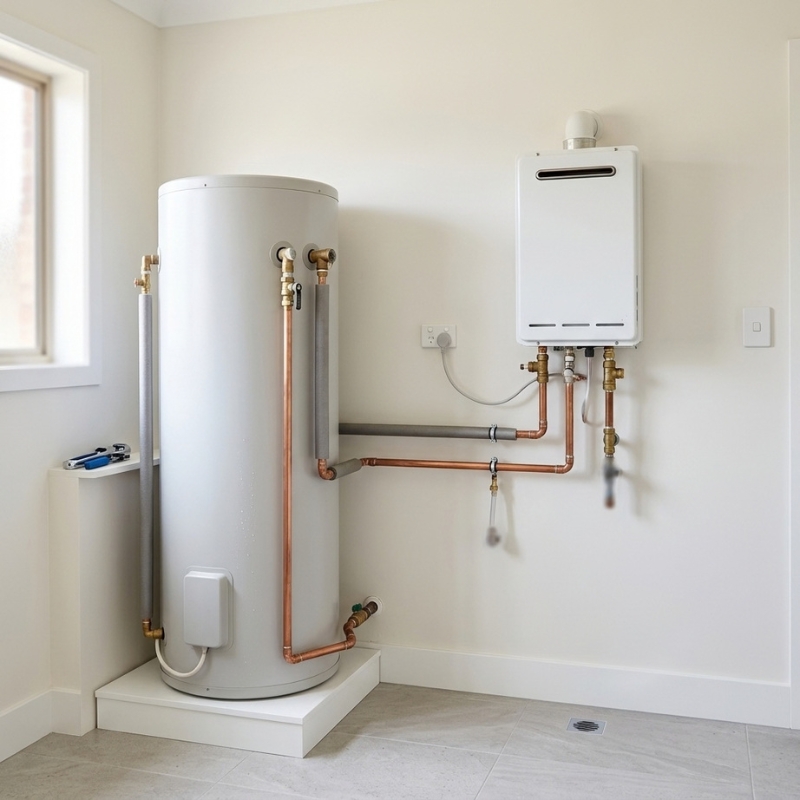
A continuous flow system heats water only while a tap is running: flow triggers the burner or element, and water is heated as it passes through a heat exchanger. A storage system heats a tank of water in advance and holds it ready. One never runs out but needs minimum flow; the other delivers instantly but has a finite volume.
Inside a Storage Hot Water System
A storage system is the familiar one: an insulated cylinder that heats a tank of water and keeps it hot until you need it. The heat can come from an electric element, a gas burner, a solar collector loop or a heat pump, but the principle is the same. A thermostat controls the temperature of the stored water, and a sacrificial anode sits inside to protect the steel lining from corrosion, slowly being consumed so the tank is not.
The behaviour you notice comes from stratification. Hot water is lighter, so it sits at the top of the tank and is drawn off from there, while cold water enters at the bottom to replace it. This is why you get full-temperature water right up until the tank is depleted, and then a fairly sharp drop to cold rather than a gradual fade. It is also why first-hour delivery, how much hot water the system can supply in the first hour including what it reheats, matters more in practice than the nominal tank size, because the recovery period (the time taken to reheat) determines how fast it bounces back after heavy use.
Two safety components are worth knowing. A temperature and pressure relief valve and an expansion control valve manage the pressure and temperature inside the tank. And because stored water is kept hotter than you would want at the tap, a tempering valve is fitted downstream to blend it down to a safe delivery temperature.
Inside a Continuous Flow System
A continuous flow system does away with the tank entirely. When you open a hot tap, a flow sensor detects the water moving, the controller fires a gas burner or energises electric elements, and the water is heated as it passes through a heat exchanger. The output is modulated continuously to hold the set temperature regardless of how much you are drawing, so the unit works harder for a bigger flow and eases off for a smaller one.
That design has real consequences, good and limiting. On the plus side, the hot water does not run out, since it is made on demand, and because there is no tank sitting full of hot water, the standing heat loss is low. The trade-offs are worth understanding before you choose one. There is a minimum activation flow, so a barely-open tap may not move enough water to trigger the heating at all. There is a short delay while the heat exchanger comes up to temperature at the start of a draw. And there is a maximum flow rate, which caps how many outlets can run hot at once before the temperature or flow starts to give.
The set temperature is controlled at the unit or a wall controller rather than by blending hot and cold at the tap. One practical point with electric continuous flow units in particular: they draw substantial electrical current when running, so the property’s available electrical supply has to be checked before one is fitted.
Heat Pump and Solar: Storage With a Different Heat Source
Heat pumps and solar systems often get treated as separate categories, but they are really storage systems with the heat source swapped out. The tank and the stored-water principle are the same, only the way the water gets hot is different.
A heat pump runs a refrigeration circuit in reverse. Instead of removing heat from inside a fridge, it moves heat from the surrounding air into the water tank, using a compressor and a fan to do it. Because it runs a compressor and fan, where it goes matters: it needs clear airflow around it, it makes some noise, and it produces condensate that needs to drain somewhere. A solar thermal system uses collectors on the roof to heat water, feeding a tank that also has a boost for when the sun is not enough. There are two main arrangements, thermosiphon systems with the tank mounted on the roof alongside the collectors, and split systems with the tank at ground level and water pumped up to the collectors. Both heat pump and solar systems include a boost element so you still get hot water in poor conditions. For how efficient any of these are and what they cost to run, the manufacturer’s published rating and any current government programmes are the places to look, since those figures are specific to the model and change over time.
Why Your Hot Water Behaves the Way It Does
This is where the mechanism becomes genuinely useful, because most hot water complaints map cleanly onto a specific cause once you know how the systems work.
- Running out mid-shower points to a storage system, where the stored volume has been depleted, or an element or thermostat has failed. On a two-element tank, a failed lower element while the upper still works gives you a reduced amount of hot water rather than none.
- A cold sandwich, hot then cold then hot, is characteristic of a continuous flow unit cycling between short, separate draws, as it stops and restarts.
- Lukewarm water at a trickle points to the minimum activation flow on a continuous flow unit, where the tap is not open enough to trigger full heating.
- A long wait for hot water at a distant outlet is almost always the length of the pipe run, not a fault with the unit at all. The hot water simply has further to travel.
- Water too hot at every blended outlet points at the tempering valve rather than the system itself, since that valve controls delivered temperature. If this is happening across the bathroom, it is worth looking at tempering valve replacement rather than the unit.
- Rust-coloured water or a rumbling tank points to sediment build-up in the tank and the condition of the anode.
- Relief valve discharge points to a pressure or temperature control issue that needs checking.
For each of these, the point is what would be investigated, not a guess at a cost. The symptom tells a plumber where to look first, which is exactly why describing what your hot water is doing is so useful.
What Determines the Right System for a Property
There is no single best type, only the one that suits your property and how you use it, and a few real inputs decide that. Worth weighing up:
- The energy source available at the property, whether that is electricity, gas or room for solar.
- Peak simultaneous demand and your pattern of use, meaning how many outlets run hot at once and when, such as several showers in one morning.
- Available electrical capacity or gas supply, since some units ask more of one or the other.
- Space, location and clearances, including somewhere for a relief valve and condensate to drain.
- Pipe run lengths to the main outlets, which affect the wait for hot water.
- Strata or body corporate constraints, which can limit what and where you install.
- Whether the existing installation needs upgrading to current standards when the unit is changed.
A replacement is also a good moment to review the tempering valve, the relief lines and the isolation at the same time, since everything is already being worked on. It is worth knowing that hot water installation and alteration must be carried out by a licenced plumber, and any gas work by a licence holder with the relevant gasfitting authorisation, which NSW Fair Trading sets the requirements for. Installation, relief valve and delivered temperature requirements are governed by AS/NZS 3500.4 and NSW Health. When you are ready to proceed, hot water system installation and replacement is assessed against those inputs for your specific property.
Frequently Asked Questions
Does a continuous flow hot water system ever run out of hot water?
It heats water on demand, so it does not run out the way a tank does. It does have a maximum flow rate, though, so running several outlets at once can reduce the temperature or flow. The minimum activation flow is the other practical limit to be aware of.
Why does my hot water go cold part-way through a shower?
On a storage system this usually means the stored volume is depleted, or an element or thermostat has failed. On a continuous flow system, a brief cold burst between draws is often the unit restarting. Both are checked rather than assumed, since the fix depends on which it is.
Is a heat pump hot water system a type of storage system?
Yes. A heat pump heats and stores water in a tank, just like a conventional storage system, but it uses a refrigeration cycle to draw heat from the surrounding air instead of an element or burner. It needs clear airflow, a suitable location and somewhere for condensate to drain.
Why is my hot water too hot at the bathroom tap?
Delivered temperature at blended outlets is set by the tempering valve downstream of the unit, not by the hot water system itself. So water that is too hot across every bathroom outlet usually points at that tempering valve rather than the unit, and that is where a plumber would look first.
Matching the system to how you live
The core distinction is simple once you see it. A storage system trades a finite volume of water for instant, full-temperature delivery the moment you turn the tap. A continuous flow system trades a minimum activation flow and a maximum rate for the fact that it never runs out. Heat pump and solar are storage with a cleverer heat source. And when something goes wrong, the symptom usually tells you which part of the system is at fault. If you are choosing a new system or your current one is not keeping up, our licenced Sydney plumbers can assess the property, recommend a suitable unit and complete the work. Speak to Apex Plumbing Services about hot water systems for your home or business.

