

Sydney Water Backflow Requirements for Property Owners
Sydney Water requires a property that poses a medium or high hazard to the drinking water supply to have a testable backflow prevention device fitted at its connection. An accredited backflow plumber assesses the hazard rating, tests the device when it goes in and every year afterwards, and lodges the result with Sydney Water.
If a Sydney Water notice has arrived about a backflow prevention device, the short version is this: your property needs a device that matches its hazard rating, and where that device is testable, it has to be tested every year by an accredited plumber. The obligation sits with the property owner.
We carry out backflow work across Sydney under NSW Licence 306733C, with more than 26 years behind it, and most of these questions end in the same place: annual backflow testing in Sydney booked before the due date. What follows is what backflow actually is, which properties need a testable device, what Sydney Water asks for each year, and how to work out whether you have a device at all.
What backflow is, in one paragraph
Backflow is water running the wrong way, out of a property and back into the public water mains.
Under normal conditions, pressure pushes water in one direction only, from the mains into your property. That can reverse in two ways: pressure in the mains drops during a burst, firefighting or maintenance work, or pressure on your side rises above it, through a pump, a boiler or a pressurised line. When it reverses, whatever that water has been in contact with travels with it. Irrigation water that has been sitting in a line among soil and fertiliser. Stagnant water standing in a fire service. Chemicals in a workshop. Fluid drawn back through dental or medical equipment. A backflow prevention device is a one-way gate at the connection, there to make sure none of that reaches the street main and the properties beyond it.
Which properties need a testable device
Whether you need a testable device depends on the hazard your property presents to the water supply, not on whether it is a house or a business.
Sydney Water rates properties as high, medium or low hazard, and the device fitted has to suit that rating. It also states that the hazard rating must be assessed by an accredited backflow plumber, meaning a licensed plumber who also holds backflow accreditation, and reassessed whenever activities on the site change.
The situations that commonly push a property up the scale include:
- Irrigation systems, where lines sit full of water in contact with soil, fertiliser and whatever else is in the garden.
- Fire services, which hold large volumes of water that can stand still for long periods.
- Rainwater tanks connected to the mains, where a top-up connection creates a path between the two supplies.
- Commercial and industrial premises, where chemicals, processes and connected equipment are part of daily operation.
- Medical and dental fixtures, where suction and aspirating equipment can draw fluid back through a line.
Low hazard properties are usually covered by a simple non-testable device built into the water meter. Medium and high hazard properties are the ones that need a testable device installed at the boundary, which is the type that carries an annual obligation.
This is why backflow prevention gets assessed property by property rather than by category. An ordinary suburban house with an irrigation system plumbed into the mains can be rated differently from the identical house next door without one, and a change of tenant or process can move a commercial site from one rating to another.
What Sydney Water requires each year
Sydney Water requires high and medium hazard backflow devices to be tested when they are installed and every year after that, by an accredited backflow plumber.
It also sets out what happens with the paperwork. The plumber lodges the test result with Sydney Water within two days of the test, and Sydney Water advises property owners to ask their plumber for a copy of the report. Keep that copy with the building records, because it is what you produce when a certifier, an insurer or an incoming tenant asks about compliance.
The responsibility is worth being clear about. Sydney Water puts the duty on the property owner to make sure the right device is installed and properly maintained. Your plumber performs the test and lodges the result, but the obligation to have it done does not transfer to them, and it does not pause because nobody sent a reminder.
Two other points follow from the same rules. First, the hazard rating is not fixed for life, since Sydney Water requires reassessment when site activities change, so a new tenant, a new process or a newly installed irrigation system can change what the property needs. Second, any fees that apply and any consequences for letting a test lapse are published by Sydney Water itself, so confirm those directly rather than taking a figure from somewhere else.
What happens during a test
A backflow test is a short physical check that the device still closes properly, carried out with calibrated gauges connected to the test cocks on the device body.
It needs a short interruption to the water supply while the gauges run, and it ends with a report lodged with Sydney Water and a copy to you.
What to do if you are not sure whether you have one
Start at the water meter, because a containment device sits at or close to the connection.
Look in the meter box near the front boundary, inside a locked enclosure or cage, on a riser near a fire booster, or in a plant room or car park near the main. On some properties it sits in a garden bed under a cover, which is also why devices go unnoticed for years.
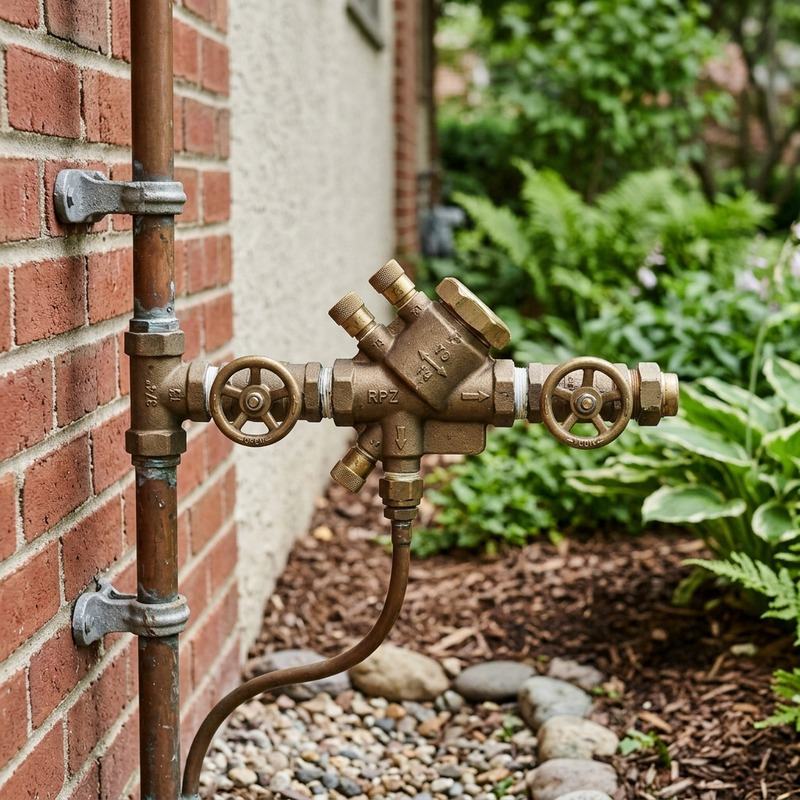
What you are looking for is a brass or bronze body sitting between two isolating valves, with several small capped taps on the body itself. Those capped taps are the test cocks, and they are the giveaway: if they are there, the device is testable and carries an annual obligation. A reduced pressure zone device also has a relief port underneath that can discharge water, usually over a drain or tundish.
On many smaller residential services, the protection is built into the meter and there is nothing separate to find.
Rather than guessing from the street, have an accredited backflow plumber check what is registered against your connection and whether a test is due. That check settles it either way, and it is considerably cheaper than discovering the answer through a notice.
Frequently Asked Questions
What is the difference between a testable and non-testable backflow device?
A testable device has small test cocks on its body, so an accredited plumber can connect gauges and confirm it still holds. A non-testable device, common on smaller residential meters, has none and cannot be checked that way. Only testable devices carry the annual obligation.
Does a residential property need backflow testing?
It depends on the hazard rating rather than the property type. Many homes are low hazard and covered by a non-testable device in the meter. A house with mains-connected irrigation, a rainwater tank top-up or similar may be rated higher, and an accredited backflow plumber determines that.
How often does a backflow device need to be tested?
Sydney Water requires high and medium hazard devices to be tested when they are installed and every year afterwards, by an accredited backflow plumber. The result is lodged with Sydney Water within two days of the test, and you should receive a copy of the report for your own records.
The practical next step
If you are not certain where your property sits, the order is straightforward: find out whether there is a testable device on the connection, confirm the hazard rating with an accredited backflow plumber, and find out when the device was last tested and lodged. If activities on the site have changed since the rating was set, that is the moment to have it reassessed rather than waiting for a notice.
If you want this checked by a licensed plumber, Apex Plumbing Services works across Sydney 24 hours a day. Phone 1300 096 668.

