







Pipe Relining vs Traditional Pipe Replacement: What Sydney Property Owners Should Compare First
When a cracked or blocked drain begins to back-up, two solutions usually appear in a Google search: pipe relining and pipe replacement. Both restore flow and structural strength, but they work in very different ways. Before booking the first plumber who can “get there tomorrow”, it pays to understand how each method affects your budget, household routine, landscaping, and long-term peace of mind.
In this guide we’ll explain the core differences, outline the situations where one approach generally outshines the other, and flag the red-tape issues that can catch Sydney property owners by surprise. You will also see real-world examples, a simple comparison table, and a short checklist of mistakes worth avoiding. If you decide that a trenchless approach is right for you, our pipe relining service page explains the next steps.
1. What Actually Happens During Pipe Relining and Pipe Replacement?
Invisible repair vs full excavation
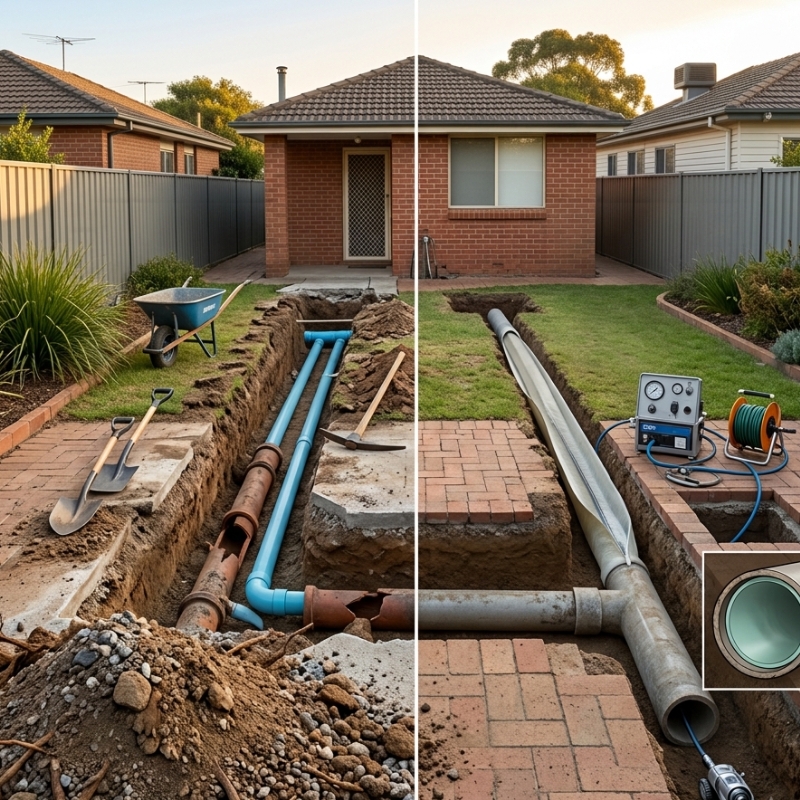
Pipe relining is often described as “keyhole surgery for drains.” A flexible liner soaked in epoxy resin is inserted through an existing access point (such as a boundary trap or inspection opening) and inflated. Once the resin cures, the liner becomes a rock-hard new pipe wall inside the old pipe, sealing cracks, gaps, and joint failures without digging.
Traditional pipe replacement, by contrast, removes the damaged section altogether. That usually means excavating a trench along the pipe’s path, cutting out the old PVC, clay, or earthenware section, and fitting brand-new pipe lengths to Australian Standards. Where access is tight (beneath driveways, extensions, or heritage landscaping), replacement sometimes needs concrete cutting, rock-breaking, or temporary removal of structures.
Typical timeframes
Relining jobs on a single residential line can often be completed in one day, including the CCTV inspection, cleaning, liner curing, and post-reline camera check. Replacement may stretch over several days, depending on trench depth, soil type, obstacles, and weather.
Compliance and inspection
Both methods require the plumber to lodge a Notice of Work with NSW Fair Trading, pressure-test the line, and book a mandatory inspection if the repair is on a house drain or main. A professional should provide you with a copy of the completion paperwork and CCTV footage for insurance or strata records.
2. The Factors That Matter Most to Sydney Homeowners
Relining is marketed as the modern upgrade, but traditional replacement is still widely performed because it can be the better fit in certain scenarios. Before deciding, it also helps to understand what problems do pipe linings help prevent, as this can make it easier to compare the long-term benefits of each approach. Let’s look at the headline factors you should weigh up before making the call.
2.1 Structural Condition of the Existing Pipe
• Localised cracks, root intrusions, or minor displacement: Relining can form a continuous, joint-free pipe that discourages roots from re-entering.
• Severely collapsed sections, missing pipe walls, or extensive deformation: Replacement may be unavoidable if a camera cannot physically pass through or if there is not enough sound pipe left for a liner to bond.
2.2 Property Access and Surface Disruption
• Inner-city terraces or paved courtyards: Digging may damage heritage paving, neighbour boundaries, or underground utilities. Relining shines here.
• Large open gardens or future extension sites: If machinery access is easy and you plan to re-landscape anyway, trenches may not be a deal-breaker.
2.3 Future Proofing and Lifespan
A high-quality liner cured to the manufacturer’s specification can last 40–50 years under normal domestic conditions. Modern PVC pipe, correctly installed and bedded, offers similar longevity. The difference is often in the joints: relining creates a single seamless length, which removes joint-failure risk entirely.
2.4 Council Approvals and Heritage Restrictions
Inner Sydney councils are protective of street trees, sandstone walls, and heritage verge materials. Trenchless repair reduces the paperwork and risk of fines for unauthorised root cutting or structure removal.
2.5 Environmental Impact
Relining generates minimal spoil, fewer truck movements, and lower carbon emissions because it reuses the host pipe as formwork. Full replacement involves transporting heavy new pipe sections, using earthmoving equipment, and disposing of tonnes of clay or PVC waste.
3. Quick-Glance Comparison Table
Below is a side-by-side summary to help weigh up your situation. (Note: real costs depend on pipe size, depth, and access, so we focus on non-price factors.)
| Factor | Pipe Relining | Traditional Replacement |
| Digging required | Usually none or minimal | Full trench along the pipe run |
| Household disruption | Low; toilets are often usable the same day | Medium to high; services may be offline for several days |
| Landscaping impact | Preserves driveways, gardens and mature trees | May require reinstatement of landscaping and hard surfaces |
| Typical timeframe | Around 1 day for a standard pipe | Approximately 2–5 days, depending on complexity |
| Longevity (when done well) | 40–50+ years | 40–50+ years |
| Joint-free result | Yes, with a seamless liner | No; joints occur at each pipe section |
| Ideal for | Tight access, heritage properties and areas with decorative landscaping | Completely collapsed pipes or sections with missing pipe walls |
| Environmental footprint | Lower spoil volume and fewer vehicle movements | Higher spoil volume and greater material transport |
| Council permits | Often simpler due to minimal ground disturbance | May require additional excavation approvals |
A table can only tell part of the story, so the next sections walk through real scenarios we see weekly across Sydney postcodes.
4. Real-World Examples from Across Sydney
4.1 Eastern Suburbs Sandstone Alleyways
Rose Bay and Paddington terraces often rely on narrow rear lanes for drainage. Excavators cannot fit, and hand trenching in sandstone is slow. Relining avoids disturbing century-old sandstone paving while giving the owner peace of mind that roots from mature plane trees are sealed out.
4.2 Hills District Clay Soil Movement
In Castle Hill and Baulkham Hills, expansive clays can push and pull pipe joints apart during wet-to-dry cycles. Where the pipe is still largely intact, a liner bridges multiple offsets in one pass, preventing new gaps opening at each PVC joint.
4.3 Northern Beaches Oceanfront Properties
Corrosive sea air can shorten the life of cast-iron stacks in older homes. When vertical stacks are embedded in walls, a pull-in-place liner saves ripping out tiled bathrooms—an option replacement simply cannot match without major demolition.
5. Common Mistakes and How to Avoid Them
- Relying on guesswork without CCTV footage
• A professional drain camera inspection pinpoints the length, diameter, and extent of damage so you understand whether full replacement is essential. - Chasing multiple spot repairs year after year
• Patch repairs on different sections can eventually cost more than one strategic reline. Map the whole problem before approving piecemeal work. - Ignoring boundary trap ownership
• Sydney Water generally owns mains, but boundary traps and house drains are the property owner’s responsibility. Know where the demarcation lies to avoid fines for unauthorised work. - Focusing solely on upfront cost
• Weigh excavation reinstatement, accommodation if bathrooms are offline, and time off work, not just the plumber’s invoice. - Assuming every plumber offers both services
• Some contractors specialise in one method. Ask for evidence of previous jobs similar to yours and check that their licence covers trenchless technology.
6. Questions That Help You Choose the Right Repair Approach
• What percentage of the pipe is missing or severely deformed?
• Is the line beneath structures you plan to keep for the next decade?
• Are there significant trees within three metres of the pipe alignment?
• Could future extensions require moving the line anyway?
• Does your insurer require a specific repair method for claims?
Taking these answers to a licensed plumber will speed up their assessment and keep recommendations transparent.
7. Compliance and Safety Considerations in NSW
All major drainage repairs must meet the Plumbing Code of Australia and be lodged on the NSW Fair Trading online portal. It is smart to cross-check that your plumber’s Notice of Work has been submitted and that post-work CCTV footage is supplied. NSW Government also publishes strict guidelines for work near its assets; you can read the latest provisions via the NSW Government plumbing and building guidelines.
8. When Does Full Replacement Still Make Sense?
Even passionate trenchless advocates admit that some pipes are beyond relining. Replacement is usually the safer call when:
• A backfall (negative slope) is confirmed, and the pipe gradient must be reset.
• Pipe fragments have washed away, leaving voids that cannot support a liner.
• Internal diameter has been reduced so much that a liner would restrict flow below code requirements.
• Future development plans require relocating the pipe completely.
If any of these apply, a reputable plumber will explain why digging is unavoidable and outline strategies to limit surface disruption.
9. What Affects the Complexity of Either Job?
Relining complexity jumps when access pits must be cut through thick concrete slabs or when multiple 90-degree bends are present. Replacement complexity climbs with deeper trenches, traffic control on busy streets, or groundwater inflow that needs constant pumping. Discuss these site-specific factors early so the quote you receive includes realistic allowances rather than “provisional sums” that grow mid-job.
10. Final Thoughts
Pipe relining has changed how Sydney plumbers tackle cracked or root-infested drains, particularly in tight urban spaces where excavation would cost a fortune in reinstatement. Yet traditional replacement remains vital for fully collapsed or badly designed lines. The smartest approach is not choosing a side, but matching the method to the pipe’s actual condition, your property constraints, and compliance obligations.
If a recurring blockage is making you second-guess your next shower, arrange a CCTV inspection first. The footage will reveal whether a seamless trenchless liner can restore the pipe or if a strategic section of new PVC is the better long-term fix.
FAQs
- Can I stay in the house while pipe relining is done?
Yes. In most single-line relining jobs the toilet may be unavailable for a few hours during liner curing, but plumbers often schedule work so basic services are restored by late afternoon. Excavation jobs can leave bathrooms offline longer, particularly if multiple fixtures share one line. - Does relining reduce the internal diameter of my pipe?
Only slightly. Modern epoxy liners add around 4–6 mm of wall thickness. For a standard 100 mm PVC or clay pipe, that still leaves sufficient hydraulic capacity to meet residential flow requirements. - Will council tree-protection rules block a full replacement?
Councils are cautious about root zones of mature street or verge trees. Relining often sidesteps the need to cut major roots, but if replacement excavation is necessary your plumber may need an arborist’s report and council approval beforehand. - How can I check that the job meets NSW standards?
Ask for the plumber’s Certificate of Compliance, the lodged Notice of Work number, and before-and-after CCTV footage. NSW Fair Trading can verify the licence status online. - Is relining covered by insurance?
Policies vary. Some insurers cover water damage but exclude repair of the pipe itself, while others now recognise relining as an acceptable method. Provide your insurer with the CCTV footage, plumber’s report, and warranty documents to confirm coverage.

